

The p-tau217 Alzheimer’s clock can now estimate when symptoms are likely to begin (new paper)
 Dr. Christin Glorioso, MD PhD10 min read
A team at Washington University in St. Louis has built a model that estimates the age at which a person will begin showing Alzheimer’s symptoms from blood measurements of a protein called p-tau217. The work was published in a new article in Nature Medicine, and the model carried a median error of about three to four years, which the authors note is on a level with how well a parent’s age at onset predicts disease timing in families that carry rare inherited forms of Alzheimer’s. A marker that clinicians already use for diagnosis is starting to look like a timeline.
The model is early, built in research cohorts rather than validated for handing any one person a personal date of onset. What makes it matter is what it demonstrates, that the information needed to estimate timing is sitting in an ordinary blood sample, which was not clear a few years ago. That points toward prediction that is cheaper and more accessible than brain scans or spinal fluid tests, and it gives prevention research a foundation to build on.
p-tau217 reflects the brain changes that come before Alzheimer’s
p-tau217 is a form of the tau protein that carries a chemical tag at one position, yet its rise is set off by amyloid rather than by tau tangles. As amyloid plaques begin to form, the brain increases the phosphorylation and release of this soluble tau, so the level climbs early, around the time amyloid becomes detectable and well before tau tangles show up on a scan. The version the WashU team relied on is reported as a percentage, the ratio of the phosphorylated form to the unphosphorylated form, which many groups write as %p-tau217. It reads most cleanly as an early marker of amyloid-driven pathology, and as the disease advances it also comes to track the growth of tau tangles, which is part of why it begins to rise years before memory changes appear.
The clock converts one measurement into an estimated timeline
Dr. Kellen Petersen and Dr. Suzanne Schindler and their colleagues drew on two long-running cohorts, the Knight Alzheimer Disease Research Center at WashU and the Alzheimer’s Disease Neuroimaging Initiative, covering 603 older adults who were living independently. They used repeated p-tau217 measurements to estimate the age at which each person’s level crossed into the positive range, then asked how that age related to the age at which symptoms later appeared. The analogy the authors use is tree rings. Amyloid and tau accumulate in a consistent enough pattern that the age a marker turns positive carries information about when symptoms will follow.
Across the two cohorts, the estimated age at p-tau217 positivity tracked the age at symptom onset with a median absolute error of 3.0 to 3.7 years, and the models accounted for roughly 34 to 61 percent of the person-to-person variation in onset age. The blood measurements came from PrecivityAD2, a test from C2N Diagnostics.
The window between a positive test and symptoms shrinks with age
One pattern in the data stands out. The interval between a positive p-tau217 result and the onset of symptoms was markedly shorter in older people. In illustrative terms drawn from the models, a person whose level became elevated around age 60 tended to reach symptoms about two decades later, while a person whose level rose around age 80 tended to reach symptoms in roughly half that time.
Fig. Probability of remaining cognitively unimpaired from AD is related to age at plasma %p-tau217 positivity.
From: Predicting onset of symptomatic Alzheimerʼs disease with plasma p-tau217 clocks
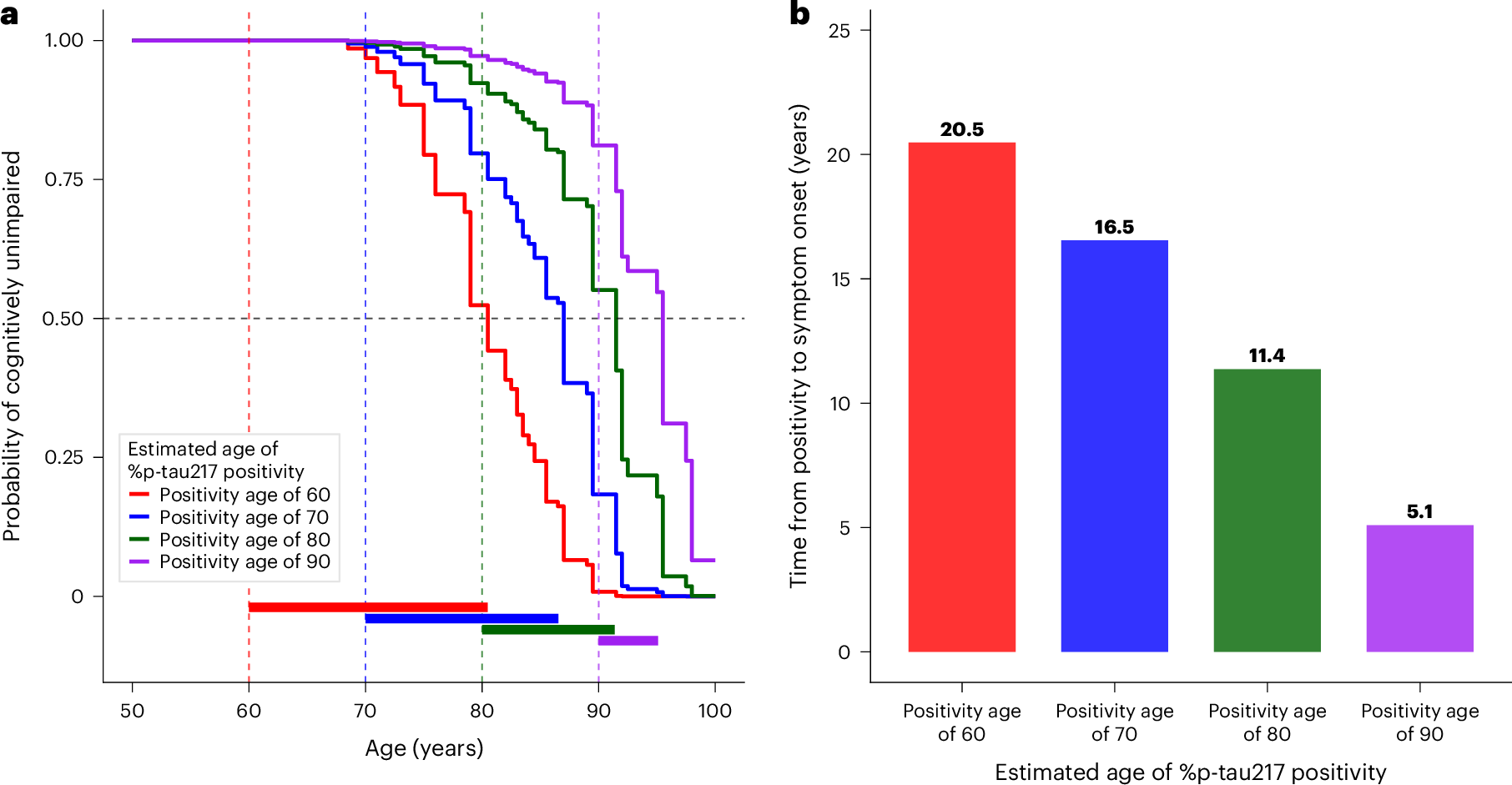
Two things temper how I read this. The age at positivity here was estimated from a model rather than observed directly, since it is read off a population accumulation curve from a single measurement, and the steeper decline in older people may reflect a mix of less brain reserve at older ages and the assumptions built into that curve. I am still a little skeptical of the idea that becoming positive later in life leaves less time before symptoms, and I would want longer studies that follow the same people serially with p-tau217 before I take it as settled.
Blood p-tau217 now matches or beats spinal fluid testing
p-tau217 reached this point because it performs well against the older reference standards. In a 2024 study across the BioFINDER-2 and Knight cohorts, plasma %p-tau217 classified amyloid status as accurately as FDA-approved spinal fluid tests, with areas under the curve between 0.95 and 0.97, and it outperformed those spinal fluid tests for tau status. A 2025 study run across primary and secondary care in Europe found accuracy near 85 percent in primary care and 89 to 91 percent in secondary care using a fully automated version of the test.
The test already has a defined place in clinical care
In 2025 the FDA cleared the first blood test to aid Alzheimer’s diagnosis, a ratio of p-tau217 to a form of amyloid, for adults 55 and older who already show symptoms. The cleared use is narrow, supporting diagnosis in people who have cognitive symptoms rather than screening people who feel well. The clock models sit one step beyond that, built in research cohorts and now moving toward the kind of validation that individual use would require. This pairs with what I wrote earlier about neurofilament light as a marker that tracks the process rather than the diagnosis.
Kidney function and a few other factors can raise the number
The reading does not respond only to Alzheimer’s pathology. Reduced kidney function raises plasma p-tau217, with larger effects in people who do not have amyloid in the brain, which can push a result upward for reasons unrelated to the disease. Body mass index and anemia also shift the levels. Expressing the result as the %p-tau217 ratio rather than the raw concentration reduces the kidney effect, which is one reason the ratio has become the preferred form.
The first strands of evidence suggest p-tau217 can be moved
p-tau217 is not fixed, and the early signs are that it responds to treatment. Amyloid-clearing antibodies move it the most, and in trials, treatment with lecanemab and donanemab reduced plasma p-tau217, with the phase 3 donanemab study showing a reduction of roughly 35 to 39 percent over 76 weeks that tracked the clearance of amyloid from the brain.
What encourages me is that the responsiveness is not limited to drugs solely aimed at amyloid. In the phase 3 EVOKE program, oral semaglutide produced measurable reductions in tau-related markers, an early sign that this pathway can shift in response to a metabolic drug rather than an antibody. The clinical readout in EVOKE was flat, though the participants already had mild cognitive impairment or mild dementia and oral semaglutide barely crosses into the brain. The strongest signal for these drugs has come from prevention earlier in the process rather than treatment of established disease, which I covered in my piece on GLP-1 drugs and dementia prevention. Read that way, the biomarker movement in EVOKE is one of the first hints that a widely used metabolic drug can reach the tau pathway at all.
The lifestyle evidence specific to this marker is just beginning. In a randomized trial of intensive diet, exercise, and stress management in people with mild cognitive impairment or early Alzheimer’s, the amyloid ratio in blood improved over 40 weeks, while p-tau217 itself held steady rather than dropping. That is consistent with lifestyle reaching amyloid-related and vascular biology first, with any effect on tau phosphorylation likely needing longer follow-up to appear. The next round of prevention trials is being built to measure exactly this, so the coming few years should begin to show whether lifestyle can bend the marker as well.
A broader question runs through all of it. As a trial outcome measure, p-tau217 has held up well, since it changes reliably over time and its rate of change tracks cognitive decline, and a recent analysis concluded it is a robust endpoint for trials in people with amyloid pathology. What is still being established is the higher bar of a validated surrogate, meaning strong evidence that lowering the marker reliably predicts clinical benefit, which will need further work to confirm. The promising part is that the marker moves at all, and moves early, which gives prevention research a fast and accessible signal to build around.
A few caveats apply when reading this at the individual level
The models come with limits that matter when the estimate is applied to one person. The accuracy the authors report is strongest at the level of groups, and the error around any single estimate spans several years. The cohorts skewed toward well-studied research volunteers, who tend to be healthier and less diverse than the general population, so an estimate for someone outside that profile carries more uncertainty. The clock also estimates the timing of symptoms, not whether any given intervention will change that timing, which is the separate question that prevention trials are built to answer.
I read this through the lens of brain aging rather than diagnosis
For years my own research has treated brain aging as something measurable, where being biologically younger than chronological age changes risk. A p-tau217 clock applies that same logic to a single pathology. It places a person on a trajectory rather than sorting them into positive or negative.
That framing matches how I think about prevention, where the aim is to act during the long window before symptoms appear. Biological age measures and blood markers such as neurofilament light already give information about that window, and p-tau217 timing adds another layer to it. At NeuroAge this is the logic behind testing that reports where someone sits on a curve rather than handing back a single yes or no.
The timing of Alzheimer’s is becoming something we can measure
The timing of Alzheimer’s is starting to look like something we can estimate from blood, not only something we describe after the fact. No single marker carries the whole picture, and p-tau217 is most useful as one input among several. It is specific to the amyloid and tau biology of Alzheimer’s and to the timing of symptoms, while neurofilament light reflects how much neuronal damage is accruing from any cause.
The RNA markers we use at NeuroAge read the molecular aging state of the brain itself, a signal that in our published work tracks Alzheimer’s risk and cognitive function. Because each reads a different layer of the same process, combining them captures more than any one alone, and adding a timing marker like p-tau217 to a panel that already measures neurodegeneration and brain aging should sharpen the estimate of where a person sits and where they are heading.


Written by
Dr. Christin Glorioso, MD PhD
Dr. Glorioso is the founder and CEO of NeuroAge Therapeutics. With her background in neuroscience and medicine, she is dedicated to revolutionizing brain health and helping people maintain cognitive vitality.
Learn more about Dr. Glorioso

