

Is it harmful to wear polyester and spandex workout clothes?
 Dr. Christin Glorioso, MD PhD23 min read
In 2024, a TikTok by Ryan-Alexandra (@ryanalexandrapetit) reached 1.6 million views. She describes herself as a lifestyle and beauty creator based between New York and Miami, with features in Refinery29, Essence, and People Chica. Her video was pretty alarmist. She called polyester “poison,” linked it to conditions like PCOS and cancer, and closed by describing wearing it as premeditated murder or suicide. For the record, polyester as a fiber has not been shown to cause PCOS or cancer. The Daily Dot, which covered the video, noted that the airline-uniform illness cases often cited in these discussions traced to contaminants like lead, arsenic, and hexavalent chromium rather than to polyester itself.
She’s not the only influencer sounding the alarm. Heather Dessinger, who writes as Mommypotamus and holds a functional-nutrition credential, runs “best non-toxic leggings” testing content for a large following.

The wellness publication, goop, ran an article quoting Kizzy Charles-Guzman of the Center for Environmental Health, whose line about “not spending the day in a sweaty polyester bra” gets repeated widely.
Underneath all of it, most of what surfaces in a search is affiliate content, sites like The Filtery, I’m Plastic Free, Lezat, and Tripulse that rank “non-toxic” brands and earn a commission on the links, which drives a large share of the volume.
The study underneath the hype
Almost none of this accurately reflects the conclusions from the single study that gave the concern its scientific spine. In 2024, a group of researchers at the University of Birmingham published a study that answered a question people had been asking for years without any direct evidence behind the answer. They wanted to know whether the chemicals mixed into plastic can leave that plastic, dissolve into sweat, and cross into the body through skin.
The study, by Dr. Ovokeroye Abafe, Dr. Stuart Harrad, and Dr. Mohamed Abdallah in Environment International, used laboratory-grown three-dimensional models of human skin. The researchers applied microplastic particles carrying polybrominated diphenyl ethers, a family of flame retardants usually shortened to PBDEs, and measured what crossed into the tissue over twenty-four hours. Up to eight percent of the applied chemical was taken up. Skin prepared with more surface fluid, to simulate sweat, absorbed more than dry skin did. The same team had already shown that these chemicals leach out of microplastics into human sweat in the first place.
Two features of the design matter for trying to apply the finding to clothing.
The particles were not textile fibers. The researchers ground down polyethylene and polypropylene in the laboratory rather than taking fibers from fabric.
PBDE flame retardants are not a standard component of athletic wear. They persist in older electronics, furniture, carpeting, and building materials.
What the study establishes is the mechanism. An added chemical can migrate out of a plastic particle into the fluid on the surface of skin and then cross the skin barrier and sweat accelerates the process. Whether that same mechanism operates in a polyester shirt during a workout, and at what magnitude, requires different evidence. That evidence exists in a scattered and partial form, which I will go through.
First though, some history on how these fabrics came to be in the first place.
Two mid-century inventions converged on the gym
Polyester came first, out of a race to beat nylon. In March 1941, two research chemists at the Calico Printers’ Association in Manchester, England, named John Rex Whinfield and James Tennant Dickson, created Terylene. Wartime secrecy kept the patent from publication until 1946. DuPont acquired the American rights and brought the fiber to market in the early 1950s as Dacron, advertised as a miracle fabric that resisted wrinkling. The polymer itself is polyethylene terephthalate, usually shortened to PET and it is the same material used to make clear beverage bottles.
Spandex came second, and it was made by modifying polyester. DuPont wanted a synthetic replacement for the rubber in women’s girdles and foundation garments, which was hot and heavy to wear. A chemist named Dr. Joseph Shivers spent most of a decade on the problem. In the early 1950s he modified Dacron polyester with an intermediate substance and produced a fiber that could stretch to five times its length and then snap back into shape without losing its elasticity at high temperatures. It was called Fiber K internally and released as Lycra. Elsewhere in the world it is called elastane. The generic North American name, spandex, is an anagram of “expands.”
The fitness industry then married them. Lycra was repositioned toward athletics when the French Olympic ski team wore it in 1968 and the aerobics boom of the following decades carried it into leotards, cycling shorts, and leggings. Polyester was reengineered in parallel for sweat. Nike launched its Dri-FIT line in 1991, built on polyester microfibers designed to pull moisture off the skin and spread it across the outer face of the fabric for faster evaporation. Under Armour launched in 1996 around a moisture-wicking synthetic shirt. By the early 2000s every major athletic brand had a proprietary version of the same idea.
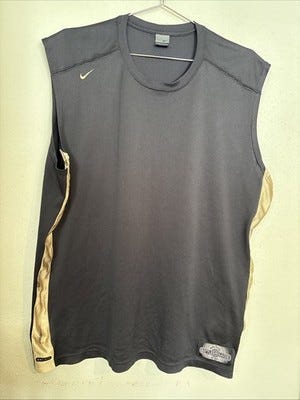
The result is the fabric most of us exercise in. A typical pair of performance leggings runs somewhere between eighty and ninety percent polyester with ten to twenty percent spandex, though many premium brands build on nylon with spandex instead. Polyester wicks better and costs less. Nylon feels softer and holds odor less readily. Both are plastics and both are almost always blended with spandex, because spandex is what allows a garment to move with a body through a squat and return to shape afterward.
None of this was developed with skin absorption in mind. Polyester was designed for wrinkle resistance and durability. Spandex was designed to replace rubber. What migrates out of these fibers into wet skin over hours of contact, several times a week, across decades, was not a question anyone was asking in 1941 or in 1958.
The alarm bells about these fabrics started ringing recently and from several directions at once. One thread came from workplaces. Beginning around 2016, flight attendants at Alaska, American, Delta, and Southwest reported skin and respiratory reactions after their employers switched to new synthetic uniforms, and a 2018 Harvard study of 684 Alaska attendants documented an increase in rashes, itchy eyes, and sinus symptoms after the change. The record on cause stayed mixed, since a federal health agency and several courts found the evidence insufficient while one jury later held a uniform manufacturer liable, and the reactions were tied to finishing chemicals and contaminants rather than to the fiber, but the episode planted the idea that a synthetic garment could make a person sick.
A second thread came from microplastics being reported in the human placenta in 2021 and in human blood in 2022, where half the samples contained PET, the plastic that polyester is made from, and in brain tissue in the 2024 work described earlier, and each finding drew heavy coverage.
A third thread named brands, when the Center for Environmental Health’s BPA testing and legal notices in 2022 and 2023 named Nike, Athleta, and others. The 2024 University of Birmingham study then supplied a mechanism people could point to, and the TikTok and affiliate-blog ecosystem compounded all of it into the version that now circulates.
Several separate lines of evidence bear on harm
Synthetic garments shed constantly, and washing accounts for only about half of it. A 2020 study in Environmental Science & Technology by Dr. Francesca De Falco and colleagues measured how many fibers polyester garments release, both into water during laundering and into the air during ordinary wear. These fragments are called microfibers, meaning strands of plastic small enough that they are difficult to see and impossible to filter out of wastewater. The numbers came out as follows.
A conventional wash released up to about four thousand fibers per gram of fabric.
Twenty minutes of normal movement released up to about four hundred fibers per gram into the air.
Scaled to a year, one person releases roughly three hundred million microfibers into wastewater from washing and roughly a billion into the air from wearing.
Construction matters. Fabrics with a loose knit and those made from short fibers spun loosely together shed considerably more than tightly woven fabrics made from long strands twisted tightly. Garments also shed more as they age.
Most of what sheds during wear becomes household dust rather than something crossing skin. Intact skin is an effective barrier against particles of this size and the main routes by which microplastics enter the human body remain breathing them in and swallowing them. That is the likeliest origin of the accumulation measured in brain tissue examined at autopsy, which I covered in Microplastics and the Brain. A shedding workout shirt is a contributor to the air a person breathes, which is not a small thing given that the fibers do not break down.
Antimony is specific to polyester rather than to a coating applied afterward. Antimony is a metal and a compound of it called antimony trioxide is added to the vessel during the reaction that makes PET, where it speeds the reaction along without being consumed by it. Chemists call a substance that does this a catalyst. Antimony trioxide is classified as a possible human carcinogen, meaning there is limited evidence that it can cause cancer in people. Because it is present while the polymer forms, antimony ends up distributed inside the fiber rather than sprayed onto the surface at the finishing stage, which means it cannot be washed off the way a coating can.
Some of it comes out into sweat. A 2021 study in Regulatory Toxicology and Pharmacology by Dr. Marc Biver, Dr. Andrew Turner, and Dr. Montserrat Filella measured how much antimony was present in polyester fabrics meant to sit against skin, finding roughly 125 to 470 micrograms in every gram of fabric, which is a few ten-thousandths of the garment’s weight. When those fabrics were soaked in a standardized liquid formulated to mimic human sweat, somewhere between about 0.05 and 2 percent of that antimony came out of the fiber and into the liquid.
Whether the resulting exposure matters is a separate question. A risk assessment in Textile Research Journal by Dr. Joaquim Rovira and colleagues estimated the dose a person would absorb from wearing polyester and divided it by the dose regulators consider safe, a ratio called the hazard quotient. Anything under one falls below the level of concern. Antimony averaged 0.4 for adults across the garments they tested, although one polyester t-shirt in the sample came out above one.
The most actionable detail in this work concerns timing. The bulk of the antimony that comes out at all comes out during the first soaking. Washing a new synthetic garment before wearing it, ideally more than once, removes most of what would otherwise be available to sweat. Low concentrations continue to release after repeated laundering cycles. This reduces the exposure rather than ending it.
Bisphenol A has been detected in polyester-spandex activewear, through testing conducted for litigation. Bisphenol A, usually shortened to BPA, is an industrial chemical used in making certain plastics and resins. California’s Proposition 65 is a state right-to-know law that sets a ceiling on how much of a listed chemical a product may expose a person to before the product must carry a warning label. For BPA absorbed through skin, that ceiling is three micrograms per day. The Center for Environmental Health, a California nonprofit that brings cases under that law, reported testing indicating that some activewear could expose wearers to as much as forty times that amount. Across several rounds of testing covering sports bras, athletic shirts, leggings, and shorts, the organization reported finding BPA only in polyester-based clothing containing spandex.
The evidence has limits that determine how far it reaches.
It was not peer reviewed, meaning it was not evaluated by independent scientists before release.
It measures how much BPA is in a garment, not how much a person wearing that garment absorbs.
Proposition 65 ceilings are set conservatively by design.
The human absorption data comes from elsewhere. Most of it involves swallowing BPA or handling the heat-printed paper used for store receipts, rather than wearing it.
Extending those receipt findings to activewear rests on a reasonable premise. The receipt studies show BPA reaching the bloodstream after seconds to minutes of skin contact, while athletic garments are worn for hours against skin kept deliberately wet. It remains an extension rather than a measurement. BPA does not build up in the body and the concern rests on its ability to imitate estrogen and interfere with the body’s hormone signaling while it is present, a property called endocrine disruption. I have written about the broader evidence on bisphenols in What’s Leaching Into Your Beans?
No study has yet measured the absorbed dose in a person wearing an actual garment. The individual steps of the pathway have each been demonstrated on their own. Added chemicals are present in the fabric, sweat pulls some fraction of them out, and skin absorbs some fraction of what sweat pulls out. Nobody has assembled those fractions into a measurement taken from someone finishing a workout and no study following large populations over time has connected wearing polyester clothing to a disease outcome. The absence of that measurement means the size of the exposure remains an estimate built on assumptions, in either direction.
What about yoga pants?
Leggings fit closely, cover a large area of skin, generate friction with every movement, and stay on for hours during and often after exercise. Every condition that the laboratory work identifies as increasing absorption is present at once. The reason to look at them separately is that the answer depends on which plastic a given pair is built from, and the label will tell you.
Polyester with spandex is the most common construction, usually eighty to ninety percent polyester and ten to twenty percent spandex. This is the combination that carries antimony inside the fiber and it is the only combination in which the Center for Environmental Health reported finding BPA. Both documented exposures apply.
Nylon with spandex is what many premium brands use, often around seventy to eighty percent nylon. Nylon is not PET. It is made without an antimony catalyst and contains none. It also falls outside the reported BPA findings. Neither documented exposure applies. The same Textile Research Journal risk assessment that flagged antimony in polyester found elevated chromium in black polyamide fabrics, which is the fiber family nylon belongs to. This can cause allergic contact dermatitis. Lululemon and Alo Yoga are brands in this category, which in part explains their popularity.
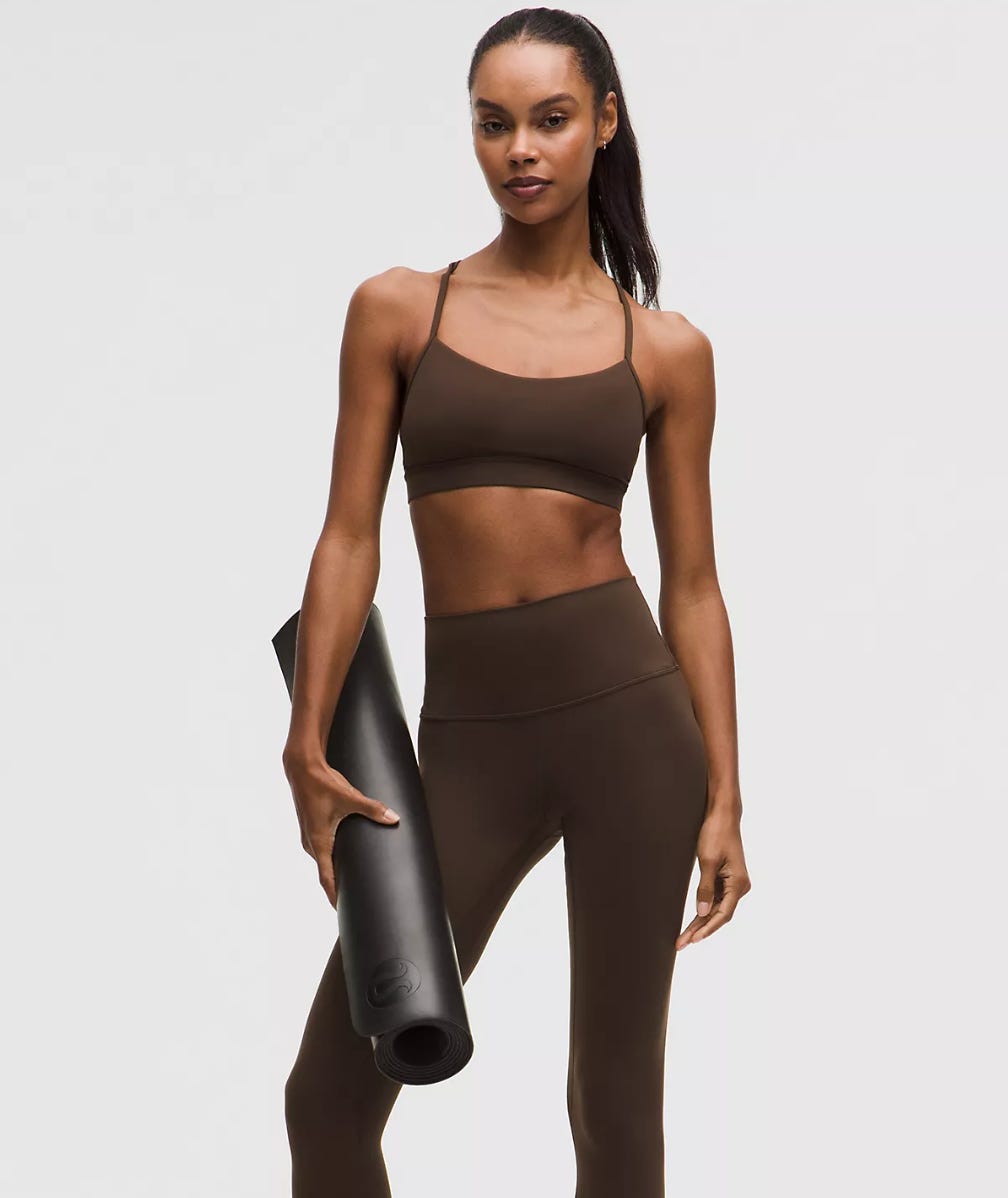
Lululemon brand apparel Cotton with spandex removes the synthetic base fiber entirely. It absorbs sweat rather than moving it, which is why it is uncommon in leggings meant for heavy exercise.
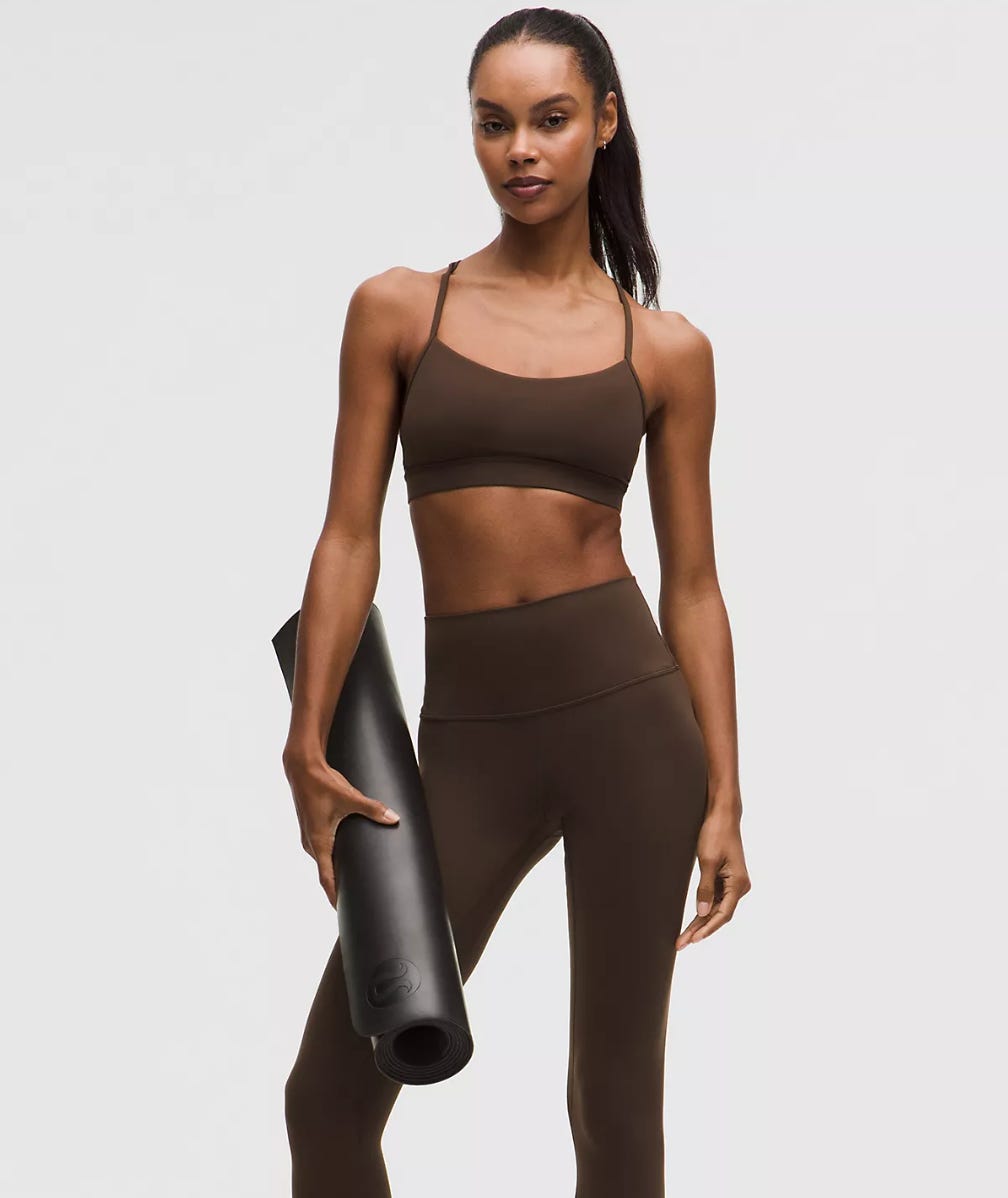
Spandex itself has been studied far less than the fiber it is blended with. It is a polyurethane-based elastic fiber and almost every measurement discussed in this article was made on the polyester or the finishes rather than on the stretch component. Nobody has looked closely at what a spandex thread releases into sweat, in part because it never appears alone. Whatever the answer turns out to be, it applies to essentially every legging on the market, including the nylon ones.
So the practical distinction is between polyester leggings and nylon leggings. Nylon-spandex avoids both of the exposures that have actually been measured in activewear, which makes it a reasonable interim choice for the garment where merino and cotton do not work. It is not evidence of safety, because so little has been measured. It is the absence of two specific findings that have been established elsewhere.
Rayon sits outside this comparison, because it is not a plastic. Some of my favorite super soft t-shirts are 95% rayon, 5% spandex. Rayon, along with modal and Tencel, is regenerated cellulose, meaning wood pulp that is dissolved and re-spun into fiber, which leaves the finished thread chemically closer to cotton than to polyester or nylon. A rayon-spandex shirt therefore carries no antimony, and the fibers it sheds are cellulose that breaks down rather than plastic that persists. It also does not wick, since rayon absorbs sweat and holds it against the skin, which is why it suits an everyday shirt more than a hard workout (although I do workout hard in mine). The harms most associated with rayon sit in its manufacture, where conventional viscose production uses a neurotoxic solvent that mainly threatens factory workers, rather than in wearing the finished garment, and the spandex blended into it is the same fiber left unstudied everywhere else.
The performance-oriented versions almost always use bamboo viscose, which is the same fiber. "Bamboo" leggings are the big category here, and bamboo fabric is rayon, made by dissolving bamboo pulp through the same viscose process. Spun Bamboo, Boody, and GYS make yoga pants that are typically a blend like 70% bamboo viscose, 20% organic cotton, 10% spandex, or 60/25/15. These are marketed for yoga and are the closest thing to a genuine rayon-based yoga pant. So when you see "bamboo yoga pants," you're looking at rayon-spandex, often with cotton added.
What the current evidence supports doing
Washing new synthetic garments before the first wear, more than once. This removes the majority of the antimony that would otherwise be available to migrate into sweat. Of everything on this list it has the most direct experimental support behind it.
Changing out of exercise clothing shortly after finishing. Contact time is what every proposed absorption mechanism depends on. This was also the interim recommendation from the group that conducted the BPA testing.
Choosing polyester without spandex where that option exists, and nylon-spandex or bamboo/rayon over polyester-spandex for leggings. BPA has been reported only in the polyester-spandex combination, and nylon carries no antimony.
Looking for OEKO-TEX Standard 100 certification. This independent testing label caps the amount of various substances a fabric may contain. For clothing it limits the antimony that can be pulled out of the fiber to under thirty micrograms per gram, a fraction of what the untested polyester samples above contained.
Not relying on the polyester percentage on the label. In the antimony work, one entirely polyester t-shirt crossed the safety threshold while other polyester garments averaged well below it, and the difference came from how much antimony the fiber contained rather than from the blend ratio. This is why certification tells you more than composition does. A certified garment has a capped antimony load whether it is eighty or a hundred percent polyester, and an uncertified one gives you no way to read the load off the label.
Merino wool for shirts and base layers. It wicks well, resists odor without the added bacteria-killing coatings used on synthetics, and contains none of the compounds discussed here. It performs poorly as a legging, which is the practical constraint on converting bottoms.
Cold, gentle, less frequent washing with a bag designed to trap shed fibers. This one is environmental rather than personal. It belongs on the list because the environmental case stands on firmer ground than the personal one.
Replacing garments gradually as they wear out. This captures most of the benefit. Household dust, food packaging, and drinking water remain larger contributors to total exposure, and I mapped those out in How to Measure and Reduce Your Exposure to Toxins.
What would the ideal fabric look like, and who is building it?
The properties we want from activewear turn out to be separable. Wicking, odor resistance, stretch, wrinkle resistance, and low shedding come from different features of a fiber, which means they can be solved one at a time rather than all at once. That is what the materials industry is currently doing, though mostly for reasons of carbon footprint and recyclability rather than for anything to do with what a garment releases into skin.
The odor problem is a surface problem, and it is well characterized. In a 2014 study in Applied and Environmental Microbiology by Dr. Chris Callewaert and colleagues, t-shirts worn during an hour of intense cycling were assessed by a trained odor panel, and the polyester shirts smelled worse than the cotton ones. The reason was bacterial. Sour-smelling microbes called micrococci grew on almost all the synthetic shirts and almost none of the cotton, because polyester’s smooth water-repelling surface gives them a foothold that cotton and wool do not. This is why so much synthetic activewear carries an added bacteria-killing coating, which is a chemical fix for a problem the fiber created. Wool needs no such coating, since its protein structure makes poor real estate for the same bacteria.
Antimony-free polyester already exists and is being sold. The antimony catalyst can be swapped for a titanium-based one, and suppliers including Clariant now market titanium catalysts for PET production that drop into existing lines. The pressure driving the change comes from food-packaging concerns about heavy metals rather than from clothing, but the relevance is direct, since a fiber made this way does not contain the antimony the sweat studies measured. Almost no activewear is marketed on this basis.
Stretch is the hard part, and it is being attacked from three directions.
Bio-based spandex replaces the petroleum feedstock with plants, using inputs like the corn-derived QIRA in Lycra fiber or sugarcane in Hyosung’s version. These change where the carbon comes from, but the finished polymer is the same polyurethane, so there is no reason to expect a different result from a sweat study.
Degradable spandex targets what happens after disposal. Asahi Kasei’s Roica V550 is certified to break down without releasing harmful substances, though it degrades only partially over 270 days and falls short of the formal definition of biodegradable.
Spandex-free stretch removes the fiber entirely. Bicomponent yarns pair two polyesters that shrink at different rates so the yarn crimps under heat and springs like elastane without being elastane, and melt-spun fibers such as XLANCE achieve stretch without the solvent that conventional spandex production depends on.
The base fiber is also being reinvented. Two approaches are furthest along. One replaces petroleum-derived polyester with a plant-derived polymer that breaks down rather than persisting. The other takes cotton, a fiber that already resists odor and sheds nothing plastic, and engineers it to perform like a synthetic. Both are described below.
A set of startups are building around this question, mostly by subtraction. Note, I have no experience and no relationship with any of these companies.
Reprise makes activewear from Tencel, a fiber derived from eucalyptus, together with organic cotton, and its founder Mary Bemis has said the company is working to bring its remaining seven percent spandex content down to zero by finding a plant-based alternative. Going to zero stretch fiber is the step nobody else in performance apparel has managed.
Kintra Fibers, based in Brooklyn, is not a clothing brand but a materials company that makes a plant-derived polyester breaking down under the right conditions, and it is now scaling production through the specialty supplier Selenis. Pangaia has been developing garments with it.
Natural Fiber Welding takes cotton that has already been grown and bonds the fibers into a yarn, through a process it calls CLARUS, that behaves like a synthetic. Its pitch is displacing plastic with cotton that already exists rather than planting more.
Yulex, in Seattle, made the rubber-based foam that replaced neoprene in Patagonia’s wetsuits and has since moved into elastic fiber built from certified natural rubber.
Mamavation, a consumer advocacy site rather than a company, commissioned an EPA-certified laboratory to test thirty-two brands of leggings and yoga pants for indications of PFAS. This is the closest anyone has come to systematic screening of the category, and it came from outside the industry.
Several other labels build around organic cotton, merino, or Tencel with a small percentage of stretch fiber. The BPA finding, which appeared only in polyester with spandex, is what most of them are navigating around.
The strategy is avoidance rather than measurement, and it costs performance. A mostly organic-cotton legging sidesteps the antimony and the BPA by not containing polyester, but it does not wick, holds sweat, and loses shape faster. These brands point to certifications like OEKO-TEX or GOTS rather than to sweat-migration data from their own fabric, which confirms the absence of listed substances rather than the amount that crosses skin during a workout.
What nobody has built is the fabric that satisfies the whole specification. It would need a titanium-catalyzed or plant-derived base fiber, a bacteria-resistant surface from the fiber structure rather than a coating, and a stretch component that is mechanical or tested for what it releases into sweat. Every component exists somewhere. The companies making them are chasing carbon footprint or recyclability, and the companies avoiding polyester are giving up performance.
The gap that persists is in what gets measured. Bio-based spandex is judged on carbon emissions, degradable spandex on landfill behavior, antimony-free polyester on clarity for bottles, and certified activewear on whether listed substances clear a threshold. None of these reports a sweat-migration test on a finished garment, which is standardized, cheap, and the one the antimony researchers used. A brand that ran it and published the number would be telling us something none of the current claims do.
Where I have landed
This is a familiar position for me, the same one I reached with plastic food storage and with plastic toothbrush bristles. The data on what happens to people who wear these fabrics does not exist, the laboratory data showing how the chemicals could get in is suggestive and accumulating, and the alternatives are available and not much more expensive. When those conditions come together at once, the decision does not require certainty about the magnitude of the risk, because the cost of acting is close to zero while the cost of being wrong in the other direction accrues quietly over decades.
The environmental case sits on firmer ground than any of this, since the microfiber numbers are measured rather than estimated, and reducing synthetic textile use is defensible on that basis alone.
So I am swapping out my yoga pants. The polyester-spandex pairs go first, since those are the ones carrying both documented exposures. I will be trying out bamboo yoga pants and likely springing for some pairs of Lululemon. I will keep watching for a study that measures what a worn garment actually delivers to a wearer. Until it exists, it is reasonable for anyone optimizing over a long horizon to reduce exposure to polyester-spandex and antimony, on the understanding that the conclusion may need to be revisited when better evidence arrives.
All this to say… we will not be sending you polyester-spandex t-shirts in your Younger Contestant packages.


Written by
Dr. Christin Glorioso, MD PhD
Dr. Glorioso is the founder and CEO of NeuroAge Therapeutics. With her background in neuroscience and medicine, she is dedicated to revolutionizing brain health and helping people maintain cognitive vitality.
Learn more about Dr. Glorioso

