

Do rapamycin and exercise combine to improve function and reduce biological age?
New study results from Dr. Matt Kaeberlein and Dr. Brad Stanfield
 Dr. Christin Glorioso, MD PhD13 min read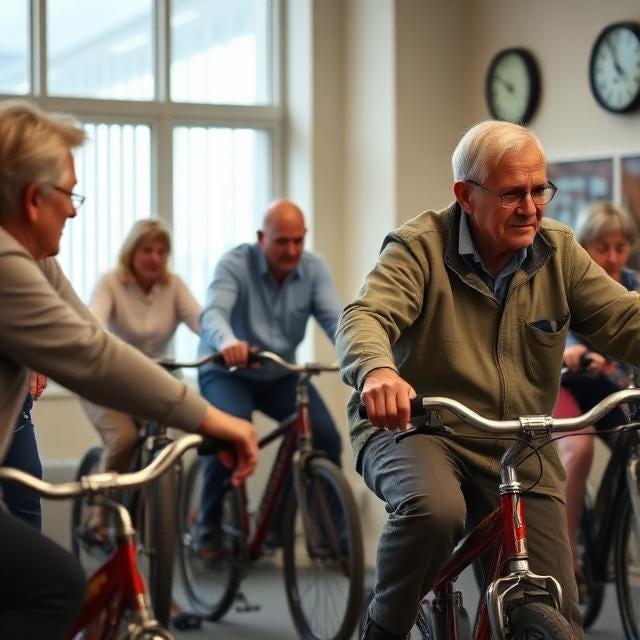
Rapamycin is a darling drug of longevity enthusiasts. It has shown consistent lifespan extension in mice across multiple independent laboratories and has become a popular off-label therapy in the longevity community. Results from a placebo-controlled trial pairing rapamycin with structured exercise in older adults have been long-awaited, both by people already taking it and by clinicians fielding questions about whether to recommend it.
The RAPA-EX-01 trial, led by Dr. Brad Stanfield with Dr. Matt Kaeberlein as co-author and senior scientific collaborator, was funded entirely by public donations. The crowdfunding campaign was facilitated by Lifespan.io and VitaDAO, and the funds (totaling $724,637) were administered by Dr. Brad Stanfield Ltd. The work was published this month in the Journal of Cachexia, Sarcopenia and Muscle. Dr. Stanfield and Dr. Kaeberlein recorded a 42-minute discussion of the results on Dr. Stanfield’s YouTube channel, walking through the data, the caveats, and points of agreement and divergence.
The trial asked whether once-weekly low-dose rapamycin would enhance the functional gains from a home-based exercise program in sedentary older adults. The work is small and exploratory, but the short answer is no, at least not in this study.
Topline conclusions of the study
Functional tests
On the trial’s main test, the 30-second chair-stand, the placebo group did about 2 more repetitions than the rapamycin group at 13 weeks, non-significant.
The 6-minute walk distance favored placebo by 4.87 meters, non-significant.
Hand-grip strength favored placebo by 1.13 kg, non-significant.
SF-36 quality of life subscores all favored placebo, with small and non-significant differences.
Aging clocks
Four DNA methylation aging clocks were measured (PCGrimAge, SystemsAge, OMICmAge, DunedinPACE). None reached statistical significance.
PCGrimAge trended toward a younger biological age in the rapamycin arm.
The other three clocks showed no clear pattern or slightly favored placebo.
Blood biomarkers and safety
C-reactive protein, a marker of inflammation, was higher in the rapamycin arm by 4.26 mg/L on average, driven by two outliers. With those two excluded, the difference fell below 1 mg/L.
HbA1c (average blood sugar) and LDL cholesterol both rose slightly in the rapamycin arm.
Adverse events totaled 99 in the rapamycin arm versus 63 in placebo. One possibly drug-related serious adverse event (a case of pneumonia) was reported in the rapamycin arm.
Crowdfunding a placebo-controlled trial of this kind, executing it through to publication, and then publishing a primary endpoint negative result is a meaningful contribution to the field regardless of which direction the data went.
Why combine rapamycin with exercise
Rapamycin is an FDA-approved drug originally developed to prevent organ transplant rejection. It blocks a cellular enzyme complex called mTORC1, which acts as a central regulator of cell growth, protein synthesis, and a recycling process called autophagy that clears out damaged cellular components. Inhibition of mTORC1 extends lifespan in mice when started even in late life, and is consistently replicated as a pharmacologic intervention against aging in animal models. I covered the broader picture of mTOR biology, rapamycin pharmacology, and the genetic variants that influence mTOR signaling in my earlier article on mTOR and longevity.
The pre-clinical rationale for combining rapamycin with exercise rests on what some researchers call the cycling hypothesis. The idea is that brief, intermittent activation of mTORC1 driven by exercise and nutrient intake, followed by extended periods of mTORC1 inhibition driven by rapamycin or fasting, might produce better adaptation than either signal alone. Exercise, especially resistance training, transiently turns mTORC1 on to build muscle. Rapamycin, given between training sessions, would in theory leave the autophagy and clearance benefits of mTORC1 inhibition intact while allowing post-exercise muscle adaptation to proceed unimpeded.
That hypothesis depends on timing. If rapamycin is still suppressing mTORC1 when the next training session begins, it should blunt rather than enhance the exercise response.
How the trial was designed
The RAPA-EX-01 trial enrolled 40 sedentary adults aged 65 to 85 (mean age 72.2 years, 47.5 percent female) at a single center in Auckland, New Zealand. Participants were randomized 1:1 to once-weekly oral rapamycin 6 mg or matching placebo for 13 weeks. Both groups performed the same home-based exercise program three days per week, consisting of 30-second chair-stand sets for resistance training and a magnetic exercycle for endurance.
The study drug was given on Day 6 of each training week, roughly 24 hours after the final exercise session of the week. The reasoning was to avoid blunting the post-exercise anabolic signal while still providing sustained mTORC1 inhibition between training cycles.
The primary endpoint was change in the 30-second chair-stand test at 13 weeks. This is a validated functional test where participants count how many times they can stand from a seated position and sit back down in 30 seconds, a measure of lower-body strength and power that predicts independent living and mortality risk in older adults. Secondary endpoints included the 6-minute walk distance, hand-grip strength, the SF-36 quality of life survey, blood biomarkers including C-reactive protein, and four epigenetic age estimates (PCGrimAge, SystemsAge, OMICmAge, and DunedinPACE).
What the trial found
Both groups improved on the 30-second chair-stand test from baseline, consistent with the well-established effect of resistance training in older adults. The rapamycin group, however, completed about 2 fewer repetitions on average than the placebo group at week 13 after adjusting for baseline performance, age, and sex. The intention-to-treat analysis did not reach statistical significance, but two prespecified sensitivity analyses did. The complete-case analysis, limited to participants with both baseline and week-13 data, and the per-protocol analysis, limited to participants who completed at least 75 percent of doses and exercise sessions, both showed a statistically significant difference favoring placebo on the chair-stand test.
The pattern across secondary endpoints went in the same direction. The 6-minute walk distance favored placebo by 4.87 meters (95 percent CI -28.97 to 19.71, p = 0.706). Hand-grip strength favored placebo by 1.13 kg (95 percent CI -3.52 to 1.18, p = 0.344). SF-36 quality of life subscores were small and non-significant, all favoring placebo.
C-reactive protein, a marker of systemic inflammation, was higher on average in the rapamycin group at +4.26 mg/L (95 percent CI -0.04 to 8.68, p = 0.152), but this was driven by two participants in the treatment arm with markedly elevated values of 17 and 50 mg/L at week 13. With those two excluded, the between-group difference fell below 1 mg/L. HbA1c and LDL cholesterol both rose slightly in the rapamycin arm, consistent with metabolic effects reported in some prior rapamycin literature.
The four DNA methylation aging clocks measured were PCGrimAge, SystemsAge, OMICmAge, and DunedinPACE. PCGrimAge is a mortality-risk clock that estimates biological age from blood methylation patterns. SystemsAge breaks aging into 11 separate physiological systems and reports them individually. OMICmAge integrates DNA methylation with proxies for proteins, metabolites, and clinical markers to predict mortality. DunedinPACE estimates the current rate of biological aging rather than cumulative age, with values above 1 indicating faster than typical aging. None of the four reached statistical significance. PCGrimAge trended toward a younger biological age in the rapamycin arm. The other three showed no clear pattern or slightly favored placebo. I covered the strengths and limitations of these clocks in my earlier article on biological age.
Adverse events were common in both groups, with 17 participants in each arm reporting at least one event, but the total event count was higher with rapamycin (99 vs 63). One serious adverse event, a case of pneumonia, was judged possibly related to rapamycin.
Weekly rapamycin at 6 mg did not enhance functional gains from exercise, and the consistent direction of the effect across multiple endpoints raised the possibility that it modestly attenuated those gains.
Why the result is biologically plausible
Acute rapamycin is known to block exercise-induced muscle protein synthesis in humans. A 2009 study by Dr. Micah Drummond and colleagues showed that a single oral dose of rapamycin given before resistance exercise blocked the early increase in muscle protein synthesis that normally follows training, along with the activation of downstream mTORC1 signaling proteins. A follow-up 2014 study by Dr. David Gundermann and colleagues showed the same blockade in the context of blood-flow-restricted exercise. Dr. Jared Dickinson’s 2011 study extended the finding to amino acid ingestion, where rapamycin again blocked the protein synthesis response.
The cycling hypothesis tested in RAPA-EX-01 was that weekly dosing far enough from the next training session would let muscle adaptation proceed normally. The pharmacokinetics of rapamycin are the obstacle here. The drug has a half-life of about 62 hours, which means that if a 6 mg dose is taken on Day 6 and the next training session falls on Day 1 of the following week, substantial drug remains on board during that workout. Dr. Brad Stanfield, the trial’s lead investigator, acknowledged this point in his discussion, noting that the dosing schedule may not have created the kind of clean off-period the cycling hypothesis assumes.
This is consistent with the older mechanistic literature. If rapamycin is present during the post-exercise anabolic window, it appears to attenuate the muscle protein synthesis response. Whether that translates into smaller gains in validated functional tests over 13 weeks is what the trial set out to measure.
How this fits with other rapamycin trials in older adults
The RAPA-EX-01 result sits alongside a small but growing body of human data on intermittent rapamycin in healthy older adults.
The PEARL trial published last year by Dr. Mauricio Moel and colleagues was a 48-week, decentralized, randomized, double-blind, placebo-controlled trial of compounded rapamycin at 5 mg or 10 mg weekly in 114 healthy adults aged 50 to 85. PEARL did not include a structured exercise intervention. Its primary outcome, visceral fat measured by DXA, did not change. Secondary outcomes showed sex-specific improvements. Women in the 10 mg group had significant increases in lean tissue mass and reduced self-reported pain, and the 5 mg group reported improvements in emotional well-being and general health. Adverse events were similar across all three groups. The compounded form of rapamycin used in PEARL has lower oral bioavailability than commercially available formulations, which complicates direct dose comparisons with RAPA-EX-01.
Earlier work on selective mTORC1 inhibition in older adults focused on immune function rather than muscle. Dr. Joan Mannick’s 2014 study of the rapamycin analog RAD001 (everolimus) showed an approximately 20 percent improvement in influenza vaccine antibody response in older adults. Her 2021 phase 2b and phase 3 trials of the related compound RTB101 in adults 65 and older showed upregulation of interferon-induced antiviral gene expression, but the phase 3 trial did not meet its primary clinical endpoint of reducing respiratory tract infections.
The human data are mixed. There are signals of benefit in immune function and possibly in body composition for women, no detectable benefit on visceral fat or biological age clocks, and now a signal in the direction of attenuated functional gains when rapamycin is combined with exercise in older adults.
Limitations of RAPA-EX-01
Several limitations affect interpretation of these results.
The sample size of 40 was powered to detect large effects only. The negative direction of the trends across endpoints is suggestive but not statistically robust. A larger confirmatory trial would be needed to know whether the modest attenuation is real.
The trial measured functional outcomes including chair stands, walking distance, and grip strength, but did not directly measure muscle-level pharmacodynamic markers. There were no muscle biopsies to confirm whether mTORC1 was actually inhibited at the time of training, no DXA-based body composition to evaluate lean mass changes, and no VO2max testing to assess cardiorespiratory adaptation. Without those measurements it is difficult to say whether the cycling hypothesis was tested cleanly or whether the dosing schedule simply failed to produce the intended pharmacology.
The exercise program was self-administered at home with adherence reported by participants. Differences in actual training stimulus between groups could contribute to observed differences in functional outcome.
The duration of 13 weeks is short relative to the timescales over which rapamycin effects on biological aging would be expected to emerge.
Implications for clinical and personal decisions
For older adults considering weekly low-dose rapamycin specifically to enhance exercise gains, RAPA-EX-01 does not support that use.
The two co-authors have publicly emphasized different takeaways. Dr. Stanfield, in the joint YouTube discussion linked above and in public statements following publication, has reiterated that he recommends against off-label rapamycin use outside FDA-approved indications and clinical trials, and treats the trial as reinforcing exercise as the first-line approach for preserving function in older adults. Dr. Kaeberlein, in a LinkedIn post following publication, has stated that his outlook on rapamycin as a possible geroprotector in humans is unchanged. His framing is that any attenuation reflects what is sometimes called “newbie gains,” meaning the early functional improvements common when previously untrained people start training. A geroprotective intervention, in his view, would be expected to help people maintain muscle over years to decades during mid- and late-life rather than augment initial anabolism in sedentary people who have just started exercising, and he predicts that a 12-month version of the trial would show different results.
For the broader question of whether rapamycin has a place in healthy aging interventions, the picture remains incomplete. The PEARL trial suggests that low-dose intermittent rapamycin is reasonably well tolerated over 48 weeks and may produce modest body composition benefits in women, including a statistically significant increase in lean tissue mass and reduced self-reported pain in the 10 mg weekly group. The Mannick studies suggest a measurable effect on immune function. RAPA-EX-01 suggests that combining the drug with an active training program in older adults does not yield the synergy that some preclinical work predicted, and may interfere with adaptation to resistance training. None of these trials addresses the questions that matter most for longevity, namely effects on age-related disease incidence, healthspan, or all-cause mortality, at the timescales required to detect them.
Exercise has well-documented effects on muscle and cardiovascular fitness in older adults, with additional effects on cognition and all-cause mortality. The relevance of muscle mass, strength, and power to healthy aging and brain health is something I covered in detail in my article on muscle and longevity.
RAPA-EX-01 establishes that the pharmacology of weekly rapamycin does not cleanly separate from anything else happening during the week, including exercise. With a 62-hour half-life, drug levels remain meaningful at the next training session, which means the cycling hypothesis as commonly formulated may not be testable at this dose and frequency. The next generation of trials may benefit from larger subject numbers and longer study duration. For people considering rapamycin specifically because they think it will help them get more out of training in their 60s and 70s, the current human evidence does not support that use.
Well designed clinical trials, such as this one, are the most important tests that we can run to move the longevity field forward. This study has added to our knowledge of the benefits of rapamycin.


Written by
Dr. Christin Glorioso, MD PhD
Dr. Glorioso is the founder and CEO of NeuroAge Therapeutics. With her background in neuroscience and medicine, she is dedicated to revolutionizing brain health and helping people maintain cognitive vitality.
Learn more about Dr. Glorioso

