

Why I founded NeuroAge Therapeutics
A personal journey in Alzheimer's prevention
 Dr. Christin Glorioso, MD PhD7 min read
When I was a kid my grandmother suffered with Alzheimer’s and my grandfather took care of her in their home. It started in her late 60s, and lasted for about 7 years before she eventually passed. It devastated the whole family, most of all my grandfather. Being a caregiver is extremely hard emotionally, physically, logistically.
I have since dedicated my life to understanding and creating better solutions for Alzheimer’s disease and other neurological disorders. This has culminated in me founding NeuroAge Therapeutics, a biotech focused on reversing brain aging to prevent dementia. I studied cell and molecular biology at the University of Michigan as an undergrad and fell in love with neuroscience my senior year.
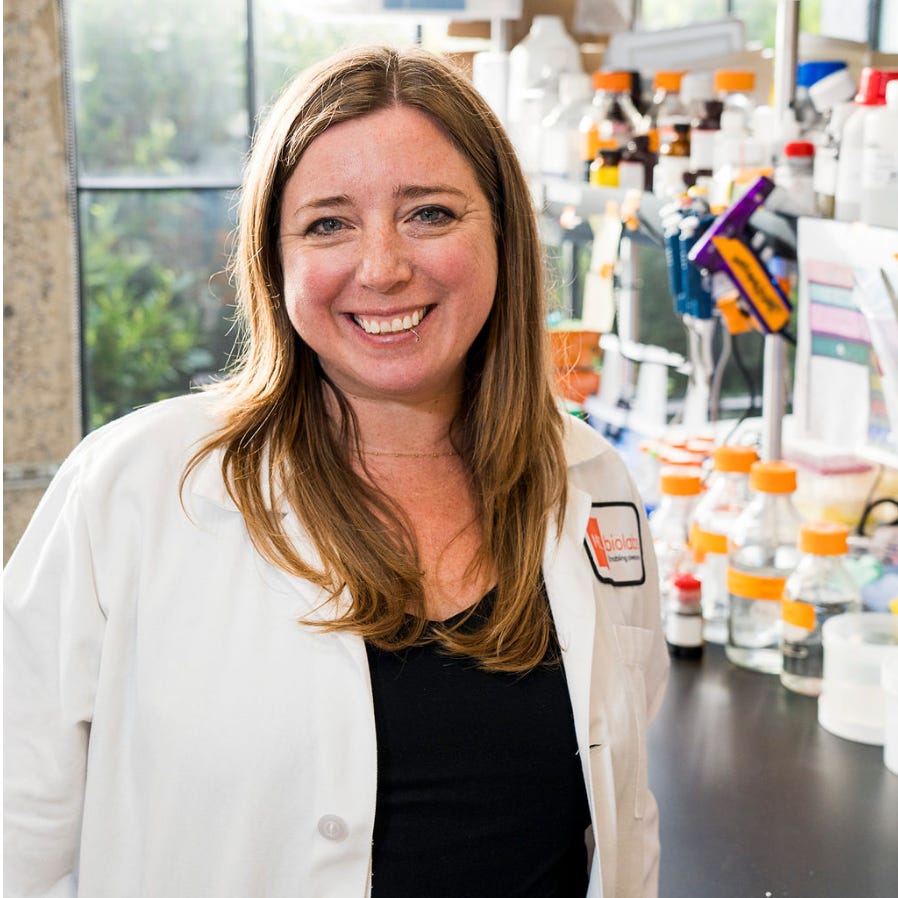
If your goal is to create new therapeutics, conventional wisdom will tell you to enter a MD/PhD program, with an eye to a career in “bench-to-bedside” research. I followed this advice after University graduation and entered a 9 year program at the University of Pittsburgh and Carnegie Mellon’s Medical Scientist Training Program. I completed my MD and PhD in neuroscience, studying normal human brain aging since aging is the largest risk factor for Alzheimer’s and other dementias. My thesis work was in the lab of Professor Etienne Sibille, then in the prestigious University of Pittsburgh Psychiatry Department, which has one of the largest human brain banks in the world.
The research that I started in 2005 during my PhD was the beginning of the science underpinning NeuroAge. At that time, there was very little we could do to treat people with Alzheimer’s. Even now, we are just on the precipice of a landslide of new drugs and tools for the disease starting with the two newly approved anti-amyloid antibody therapies and many more in the pipeline. Because of the lack of actionability for Alzheimer’s clinically, I opted not to pursue a residency in neurology or psychiatry, which was my original plan. I instead went to MIT to pursue a postdoc in the renowned aging biology lab of Professor Lenny Guarente. There I continued my research on human brain aging, collaborating back with my PhD advisor and forging new connections.
Although I love MIT, I became disenchanted with academia during my postdoc. It seemed like the incentives were not aligned for efficiently creating therapies that reach people and make a difference in their lives. We write papers and there is one little sentence at the end that says “someday this could be a drug” and then more often than not, no one actually pursues making that happen or even knows how. At the same time I caught the entrepreneurial bug, starting the MIT Think Tank with others to solve real world problems and founding my science advocacy non-profit, Academics for the Future of Science.
After leaving MIT and spending a year and a half designing COVID predictive models and building apps in the non-profit world, I moved to San Francisco to take a position as Chief Strategist of BARI, UCSF’s aging institute. Surrounded by the vibrant entrepreneurial culture of San Francisco, it became clear to me that the path forward was to create a biotech to bring new solutions for neurodegenerative disorders to the world. So I took a leap and dove into starting NeuroAge.
One of the key insights from my twenty years of research at MIT and the University of Pittsburgh were that we could in fact measure brain aging and that it was a huge modifiable risk factor for neurodegenerative diseases. In a research paper that I co-authored, we showed that people who were 5 years younger biologically than they were chronologically, were 6X less likely to develop Alzheimer’s even if they had the most common genetic risk factor for the disorder, the APOE4 allele.
I have recently learned that I have an APOE4 allele. It took my breath away when I found out especially because of my family history, but I am grateful for the knowledge. About 20% of the population has one copy of APOE4 and 2% of the population has two copies. My copy of the APOE4 gene puts me at 2-3X increased risk above the average person, making my lifetime risk of Alzheimer’s 20-30% based on my genetics alone. However, our research has shown that genetic risk for Alzheimer’s can be mitigated entirely by having slower brain aging. About 40% of your brain aging rate is due to lifestyle, which makes it an actionable risk factor. Because of this I set out to develop a test for tracking brain aging, with myself as guinea pig number one. The NeuroAge Test for brain aging is now being offered in medical clinics around the world and directly to consumers.
It is comprehensive testing and has 4 parts: brain MRI (your brain shrinks with age), cognitive testing online using our software, NeuroGames, RNA-based blood biomarkers (proprietary to NeuroAge based on my research), and genetic testing for >200 risk genes for neurodegenerative disorders. Each part of the test increases its accuracy and provides new insights into your brain health. I was pleasantly surprised to learn that my biological brain age is 6 years younger than my chronological age—see my results below.
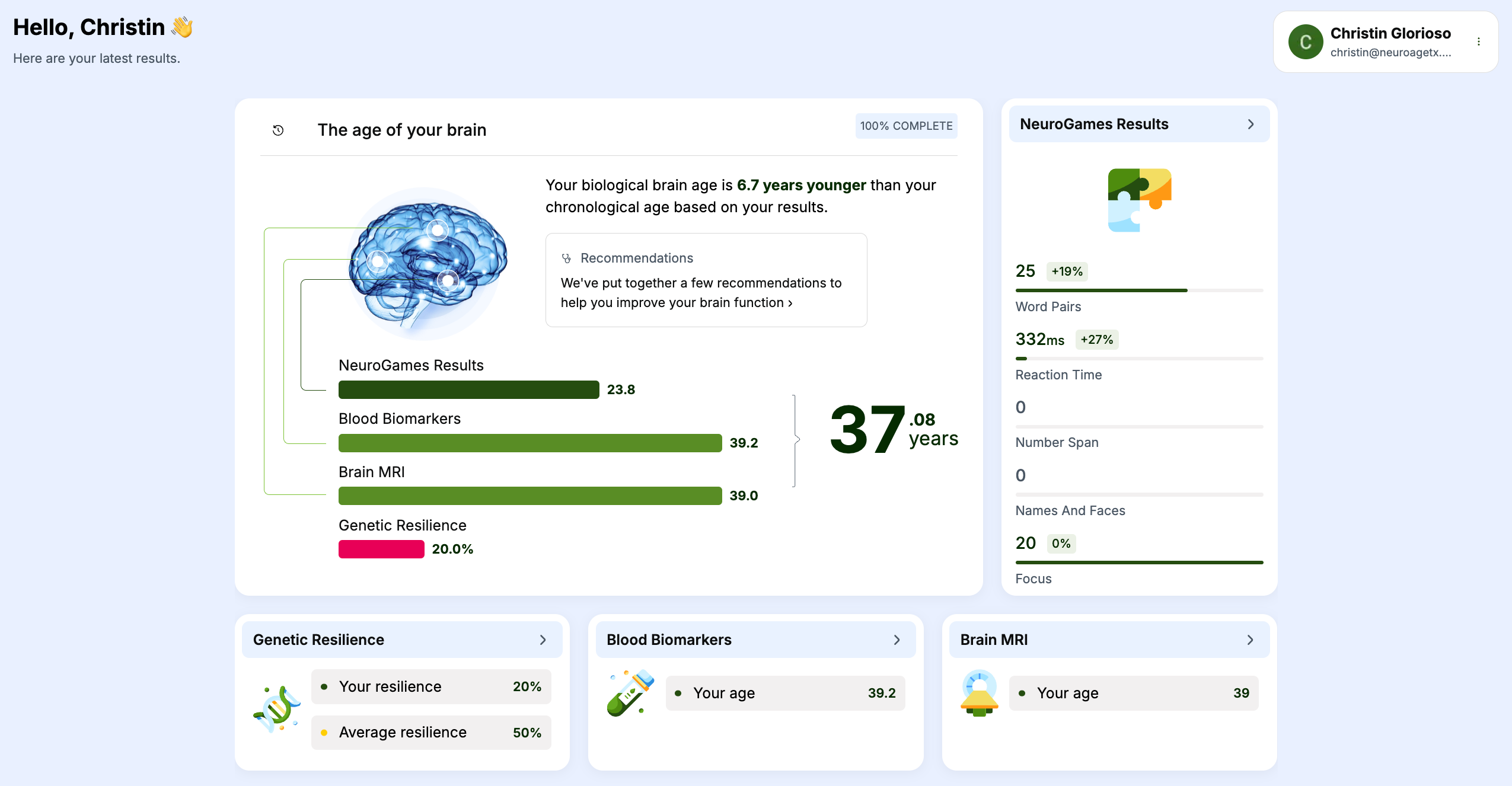
This means that I am on track to avoid Alzheimer’s disease if I live to be 85 years old. If I plan on living longer, and I do, then I need to reduce my biological brain age even further. Having a younger looking brain is also associated with better memory, reaction time, mood, and better brain health overall. I’m working on it. Stay tuned for future articles where I discuss in detail what I’m doing to slow my own brain aging and if it’s working.
I would speculate that the biggest factor for my younger brain age is being a life long exerciser. Exercise is one of the big six ways to keep your brain young:
1. exercise (8,000 steps/day)
2. sleep (8 hrs)
3. diet (mediterranean)
4. community (friends are good)
5. lowering stress
6. staying mentally active
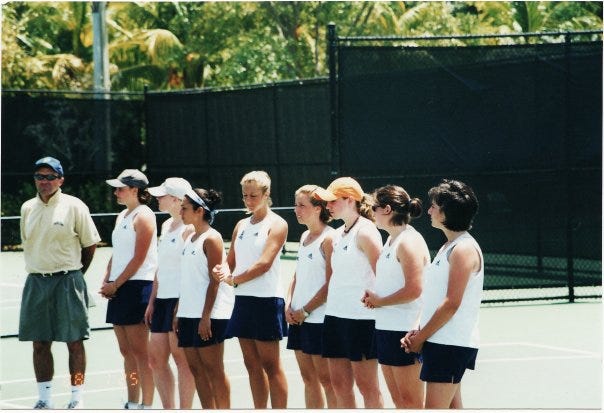
I was a state champion swimmer as a kid and captain of my high school tennis team and ran track and cross country. I played division one tennis in college and was exercising 2-3 hrs a day in my teens and early twenties. See below for a photo from college at the Big East Tennis Championships:
I currently attend a yoga class, jog, or ruck 4-5 days a week unless things become super busy with my companies, which they often do. Exercise is essential to my mental well-being and I am grateful for the lifelong habit. That said, I became pretty unhealthy during the pandemic, especially since I no longer felt comfortable going to crowded indoor exercise classes or the gym. And I still have a lot to improve on with my lifestyle.
I hope you will join me on this journey of slowing down brain aging and preventing dementia in the future. If you have questions about whether the NeuroAge Test is right for you or your loved ones, please feel free to email us to set up a complimentary zoom call to discuss at hello@neuroagetx.com.
Best wishes to you and yours for your brain health.
Christin


Written by
Dr. Christin Glorioso, MD PhD
Dr. Glorioso is the founder and CEO of NeuroAge Therapeutics. With her background in neuroscience and medicine, she is dedicated to revolutionizing brain health and helping people maintain cognitive vitality.
Learn more about Dr. Glorioso

