

Reaction time training improves brain health and lowers dementia risk by ~30%
The evidence for and amount of reaction time training to optimize cognition
 Dr. Christin Glorioso, MD PhD5 min read
I am regularly asked about whether cognitive training is beneficial for brain health and dementia prevention. While not all cognitive training has been definitely shown to be helpful, reaction time training in particular has compelling evidence.
Having fast processing speed is useful for a variety of things in life, not just improving athletic performance. It can help people catch themselves when falling and help a driver react quickly in a situation that could result in a car accident. Having fast reaction time also improves other aspects of cognition and can even decrease risk of future dementia by 30%.
I won’t go much into other types of cognitive training in this post— a review of the clinical trial evidence for commercially available brain training programs can be found here.
What is the evidence for reaction time training being beneficial?
As we age, our reflexes slow down. This has been shown consistently in many studies. Below is reaction time, as measured in the same way that we measure it in the Reaction Time NeuroGame, in more than 60,000 participants in two different cohorts. You can visualize a striking increase in time to press a key when the red light flashes with age.
If you’d like to test your reaction time, you can do so for free on NeuroAge’s webapp.
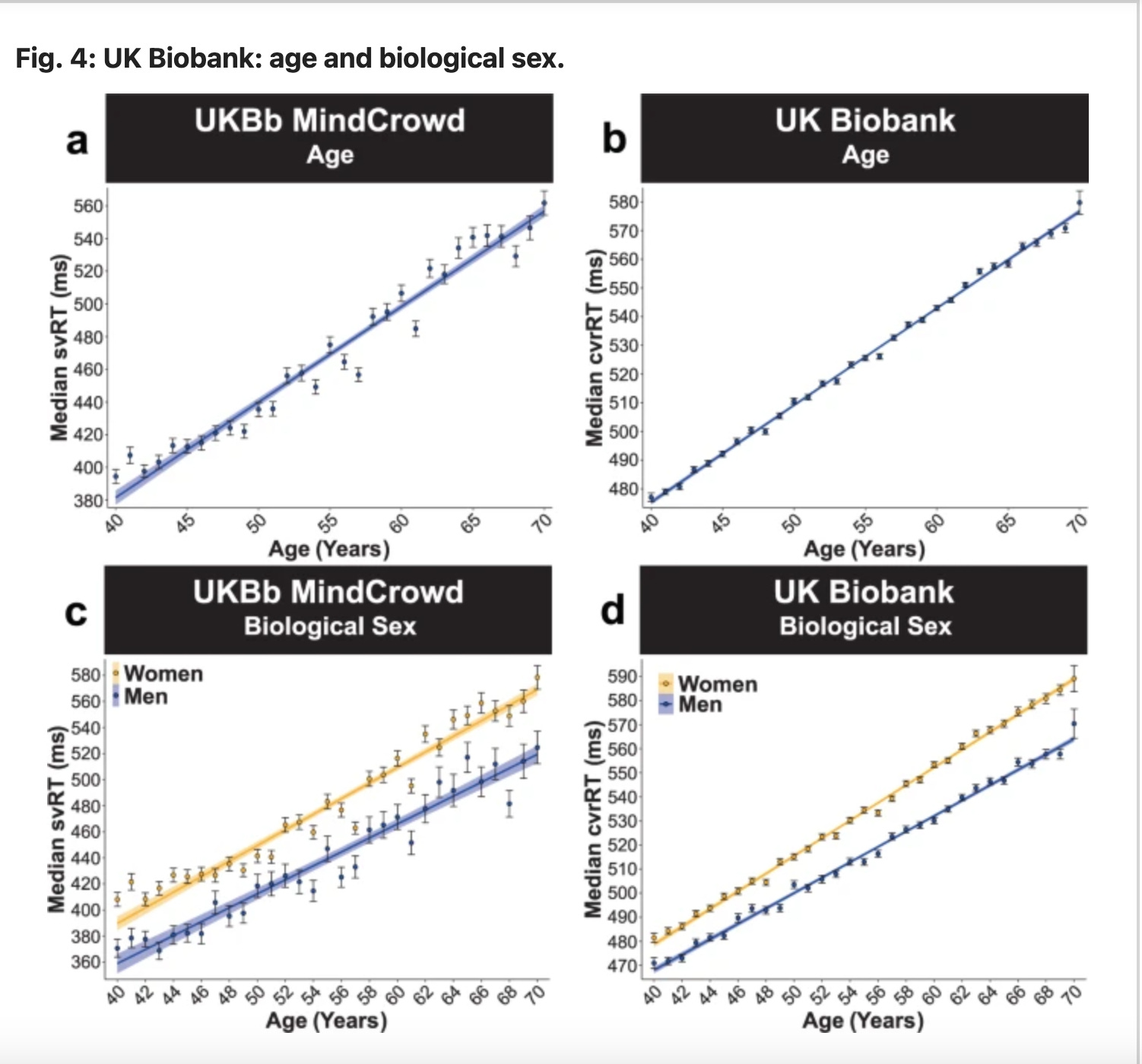
Women have slightly slower reaction time on average than men, which is why we ask about sex in our intake survey. We control for sex differences in the games when calculating NeuroAge. Women are a little better than men in some other games.
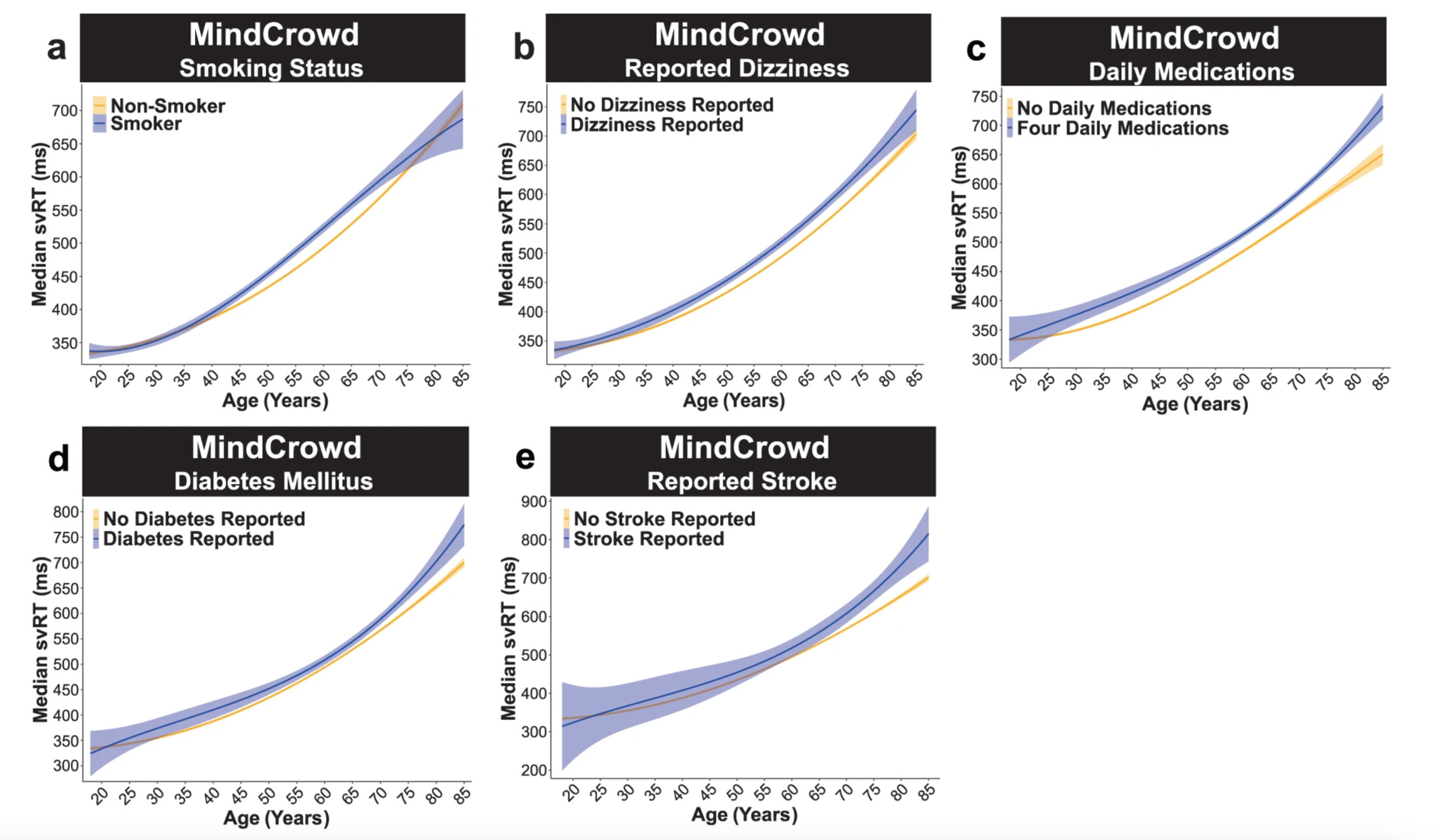
Reaction time is also a predictor of disease including stroke and diabetes in older individuals (see below).
In a study using data from the UK Biobank that created a predictive model for dementia risk 5 or 10 years in the future, reaction time was the 6th most important factor (see below). It was a more important factor than even family history of dementia.

Reaction time slows with age and predicts dementia but will improving it improve brain health?
We should be careful about conflating correlation or prediction with causation. Just because reaction time predicts dementia risk, that doesn’t mean that improving reaction time will decrease dementia risk. It could just be a marker for other types of health or lifestyle interventions that correlate with it.
There is a growing literature examining whether reaction time training can decrease dementia risk and improve other types of cognition. The data so far are supportive of a causal link between reaction time training and improved brain health.
In a study of 2,802 older adults who participated in a 6 week cognitive training program, those with speed training had ~30% less dementia 10 years later than those who did not have the training.
Because this was a randomized control trial, we can conclude that the speed training caused the decrease in dementia risk.
In this same study, memory and reasoning training did not show statistically significant benefits for lowering dementia risk, although there was about a 20% risk reduction with a trend towards significance. In a larger study where participants continue training after the first 10 sessions, these risk reductions may become significant.
How much training do you need?
In the aforementioned study, up to 10 training sessions were delivered over 6 weeks with up to four sessions of booster training delivered at 11 months and a second set of up to four booster sessions at 35 months. Outcome assessments were taken immediately after intervention and at intervals over 10 years.
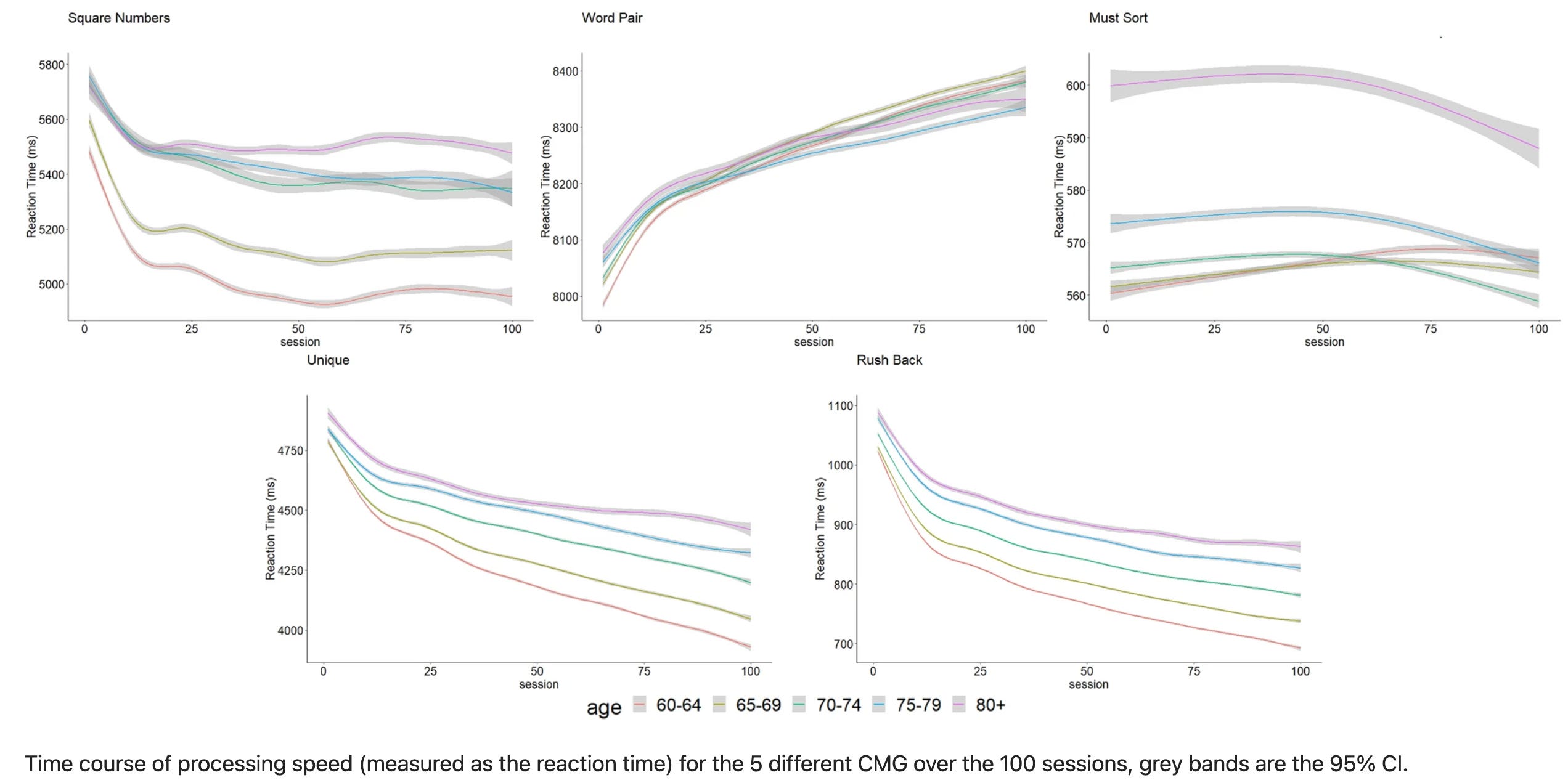
In another study, researchers asked whether different types of commercially available brain training games could reduce reaction time in people of different ages and how many sessions were optimal (see figure below).
Participants of all ages were able to improve their reaction time and the most benefit was achieved with the first 15 training sessions. However, scores continued to improve with additional training sessions, with even participants who were 80+ years old improving to times faster than the average 60 year old.
In the ACTIVE study, which is a longitudinal, randomized, single-blind clinical trial evaluating cognitive interventions in older adults (aged 65-94) in the United States, 10 sessions of training with 8 follow up sessions improved cognition by 2.5 standard deviations. A single booster session counteracted 4.92 months of age-related processing speed decline.
To sum that up, just 10 hrs of speed of processing training was shown to improve the reaction time of older adults dramatically across a 5 year period.
Summary
In conclusion, having fast reaction time is important for athletics, driving, avoiding falls, and can even improve other types of cognition and reduce dementia risk by 30%. The most benefit is seen with about 10-15 hrs of training and those benefits last for 10 years or more. Additional training sessions can continue to improve reaction time and even a single booster training session can countertact ~5 months of age-related processing speed decline.
Other interventions can also improve reaction time, like playing fast paced sports like pickle ball and ping pong, playing fast paced video games, improving sleep, exercising, and generally improving your lifestyle.
If you’d like to test and train your reaction time for free, you can do so using the NeuroAge app.


Written by
Dr. Christin Glorioso, MD PhD
Dr. Glorioso is the founder and CEO of NeuroAge Therapeutics. With her background in neuroscience and medicine, she is dedicated to revolutionizing brain health and helping people maintain cognitive vitality.
Learn more about Dr. Glorioso

