

How to Get People to Act on the 45% of Dementia That Is Preventable(new Lancet paper)
 Dr. Christin Glorioso, MD PhD16 min read
“We need surrogate endpoints. Longevity is a hard thing to prove. If you can give me a test that can predict people’s risk before they get full blown dementia, we’d be very interested in that.” That is roughly what Dr. Mehmet Oz, the Administrator of the Centers for Medicare and Medicaid Services, said at the Alliance for Longevity Initiatives H-SPAN conference this week, paraphrased from my best memory of being in the audience.
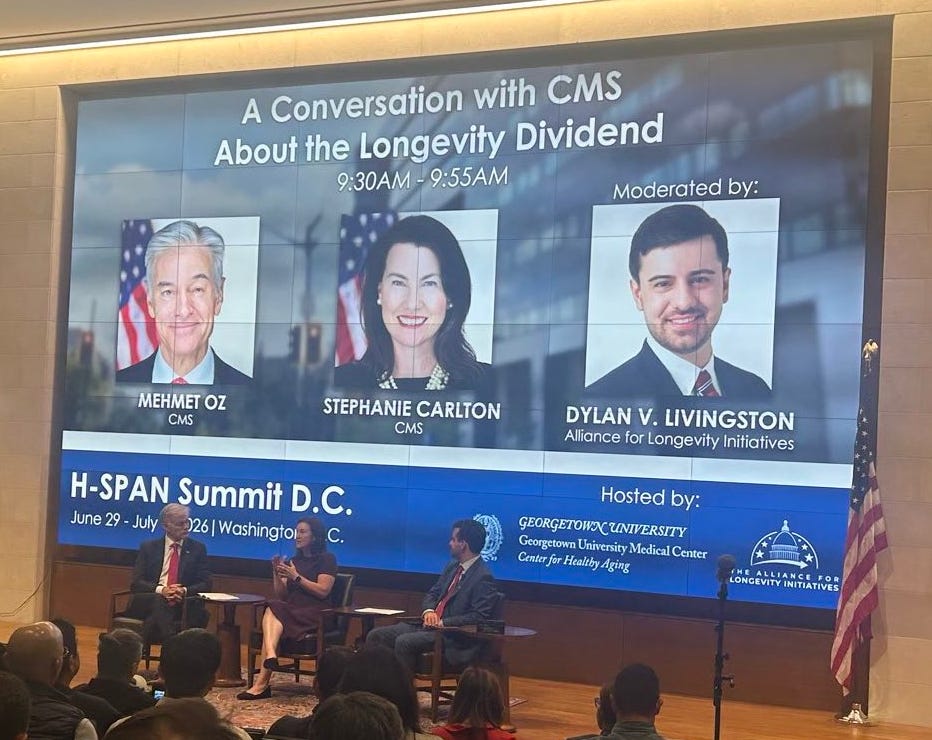
The person who runs Medicare and Medicaid wants a way to see dementia risk before it arrives. CMS covers health care for more than 160 million Americans, and dementia is one of the costliest conditions it carries, with Medicare and Medicaid already paying close to two-thirds of the nation’s dementia care bill. If we could identify the people at highest risk early and help them act on the modifiable 45%, the savings to the government could reach up to roughly $120 billion a year. A test that flags rising risk years before a diagnosis would be a clinical advance, but the spending only falls if the people it identifies then act on what it tells them.
The public is asking for the same thing. In national surveys, nearly all Americans say they would want a simple test for early detection of Alzheimer’s if one were available, and two in three want brain-health guidance from a doctor, while only about one in seven has ever received it.
The 2024 Lancet Commission put the share of dementia attributable to modifiable risk factors at up to around 45%. Getting a whole population to act on that depends on a chain of steps:
Flagging who is at high risk
Those people knowing what to do about it
Getting them to do it
The first step is the predictive test Dr. Oz was describing, and it is where objective measurement comes in. This new review in The Lancet Healthy Longevity, published on June 30, 2026, takes on the next two, and is the first to pull together the evidence on whether population-level messaging can move people through them at scale.
What we are trying to get people to do comes down to a short list.
We already know which structural levers can move dementia risk. A 2024 Cambridge-led evidence review sifted more than 4,600 studies to map the population-level policies that could shift the risk factors, from air quality rules to alcohol pricing. Those actions, drawn from the Commission’s 14 modifiable risk factors, come down to this:
Stay in education early in life and keep learning as an adult
Treat hearing loss, including with hearing aids
Keep LDL cholesterol in a healthy range
Recognize and treat depression
Protect the head from injury
Manage blood pressure
Stay physically active
Manage diabetes and blood sugar
Avoid smoking
Maintain a healthy weight
Keep alcohol within moderate limits
Stay socially connected, especially in later life
Treat vision loss
Reduce exposure to air pollution
What no one had studied was the more direct question, whether telling people about dementia risk moves them to act.
This new review asks that question. Dr. Blossom Stephan and Dr. Mario Siervo and their colleagues isolated interventions that communicate dementia-specific messaging, meaning campaigns, courses, and community programs built to change what people know and do about their own risk. They deliberately excluded efforts that targeted a risk factor without a brain-health message, such as a general anti-smoking campaign, and they describe the result as the first synthesis of population-level efforts aimed specifically at improving dementia risk knowledge and behavior. Because the whole review is about messaging, everything hinges on what those campaigns were able to measure.
Population-level approaches are needed in addition to the individual programs that already work.
The best individual-level prevention trials show that structured lifestyle change can work. The flagship trial, FINGER, was the first large randomized trial to show that a two-year program of diet, exercise, cognitive training, and blood-pressure and metabolic monitoring improved cognition in at-risk older adults. Overall cognitive scores improved about 25% more in the intervention group than in the group given regular health advice, with 83% greater improvement in executive function and 150% greater improvement in processing speed, and the benefit held for carriers of the APOE4 gene, the group at highest inherited risk. The largest and newest trial, US POINTER, reported in 2025 that a structured lifestyle program outperformed a lighter self-guided version in a group that was 69% female and 31% from minoritized backgrounds, extending the FINGER result to a more diverse population. A six-year vascular-care trial, PreDIVA, found no overall reduction in dementia, so the picture is not uniform, but the strongest and newest evidence points toward benefit.
The limitations named in the review are real, and they are mostly about reach rather than whether the approach works. FINGER’s own follow-up shows the cognitive benefit concentrates in participants who stayed engaged, which points to the central challenge of keeping people involved over time. These programs are also intensive to deliver, though a secondary FINGER analysis found no rise in total health-care costs and lower hospital use in the intervention group, so the expense sits in running the program rather than in the downstream bill. The deeper issue is that the approach with the strongest evidence depends on sustained personal engagement and recruits motivated volunteers, which means it cannot reach the roughly 45% attributable fraction across a whole population on its own. Filling that gap is the stated purpose of population-level approaches, which is why the thinness of the population-level evidence in this review carries weight.
None of these studies measured dementia, cognition, or biology.
What the studies tracked were proxies that sit upstream of dementia. The measured outcomes fell into a few categories, including knowledge and awareness of risk factors, motivation and confidence to act, self-reported changes in behavior, and in some studies a self-reported composite risk-factor score that counts how many modifiable risk factors a person reports carrying. No study measured dementia incidence, cognitive performance, or a biological marker. The connection between these proxies and actual dementia risk rests on the Commission’s estimate that roughly 45% of cases are attributable to modifiable factors, an inference the authors make carefully, noting that no included study used an objective behavioral or cognitive outcome.
The review did not pool these measures into a single result. Because the studies used different designs and different outcome tools, a combined analysis was not possible, so the authors present a narrative synthesis that groups findings by outcome type and reports each study on its own terms. There is no single effect size for population-level dementia prevention, and the authors are direct that the range of outcome types prevents comparison across studies. Any statement about what worked describes a pattern across varied self-reported measures rather than a pooled estimate.
Reach was counted separately from effect, and the two rarely lined up. The largest numbers in the review describe exposure, not measured change. The Puerto Rico social media campaign reached 294,109 people, Denmark recorded more than 140,000 completed online risk assessments, and the Belgian screening tool drew 24,700 visits. Those exposure counts sit apart from the much smaller groups whose outcomes were measured, and the Puerto Rico evaluation, for example, assessed 51 participants against a reach of 294,109. Traditional media reach was often low, with the Australian Your Brain Matters campaign reaching between 0.6 and 9.3% of people per channel, and only 2% of Belgian respondents recognizing the campaign materials. Reading broad reach as broad impact would overstate what the numbers support.
Motivating people to change has a long and mixed history.
Public health spent decades learning that information alone rarely moves behavior. The mid-century assumption was that giving people the facts would change what they did. American seat belt use sat between 11% and 14% into the early 1980s despite the National Ad Council’s decades-long “Buckle Up” campaign, and reached 49% by 1990 only once mandatory state laws and enforcement took over. Shifting behavior took a stronger lever, in this case the law rather than the message.
The clearest success worked by choosing a different lever. During the truth anti-smoking campaign, youth smoking prevalence fell from 25.3% to 18.0% between 1999 and 2002, with roughly a fifth of that decline attributable to the campaign itself. Formative research showed that teenagers already knew smoking was harmful and did it anyway, as a way to signal independence and rebellion, so more facts and more fear had little to add, and scare-based messages risked making cigarettes more appealing. Rather than lecturing, the campaign redirected that same rebellious streak against the tobacco industry itself, exposing how the companies manipulated young people, and it ran on a large, sustained budget that reached most American teenagers.
The decline in young-adult drinking shows both the promise and the difficulty of reading these shifts. Alcohol use among young adults has fallen steadily since around 2000, and Gallup surveys put the share of under-35s who drink at roughly 50% in recent years, down from about 72% two decades earlier. Rising health awareness and shifting social norms are among the proposed drivers, and it is plausible that years of coverage framing alcohol as harmful contributed. What the data do not allow is a clean causal story, because economic pressures, delayed onset, and simple life-cycle effects also fit, and some industry analyses find that participation rises again as this generation ages and earns more. The fair reading is that even the strongest example of a population behavior shift took about twenty years and resists tidy attribution to any single message.
The most reliable behavior change comes from personal, repeated feedback. Wearable activity trackers increase daily steps by around 1,800 and sustain a smaller effect for years, because a personal, repeated signal does something a campaign cannot, which is to close the loop between intention and action. The behavioral science behind this is consistent. Intentions alone explain less than a third of behavior, and simple structured plans that specify when and where a person will act carry a medium-to-large effect on follow-through. Feedback and structure move people more than facts alone. And by the way, at the A4Li conference Dr. Oz spoke about how wearables are slotted for medicare reimbursement and CMS is very positive about this but companies that make them need to produce clinical trial evidence of efficacy to back up claims.
What the review found was uneven, with one approach standing out.
Knowledge improved in eight of the eleven studies that measured it, while behavior barely moved in the broad campaigns and was captured only by self-report, since no study measured it objectively. The only approach that shifted behavior meaningfully, a personal risk profile paired with a short course, cut self-reported risk factors by about a quarter in a motivated group. The review’s conclusion is that messaging reliably improves knowledge, while whether it changes behavior at population scale is still an open question. The lever it points to is personalization, which is also the single thing our NeuroAge customers ask for most. That does not make broad awareness campaigns useless, since they raise knowledge widely and can route people toward the personalized guidance that moves them to act, but awareness on its own does not close the gap between knowing and doing.
Educational programs produced the most consistent knowledge gains. The clearest single campaign figure is the Wuhan opinion-leader effort, which lifted awareness from 44% at baseline to 73%, though the broad mass-media campaigns were far weaker, several showing no change in awareness that risk can be reduced, and only 2% of Belgians recognized their campaign’s materials. Behavioral outcomes, where they were measured, were mostly self-reported intentions and lifestyle changes rather than verified action, and several campaigns did report more self-reported healthy changes among people who recalled being exposed, a comparison that invites selection bias.
The strongest result paired a personal risk profile with education. The best-performing intervention was ISLAND, an open online public health program that any Tasmanian resident over 50 could join, which combined a personalized dementia risk profile with a short online course. That open, scalable delivery is why it counts as a population-level program rather than an individual one, and it was the only intervention in the review to pair that reach with personalization, which is what set it apart. The average participant’s count of modifiable risk factors fell from 2.17 to 1.66 over three years, a reduction of about 24%. That was the strongest behavior result in the review, where most other interventions moved knowledge more than action. Its roughly 3,000 participants were self-selected, 71.6% female, and averaged 63.7 years, a highly engaged group, and the outcome was a self-reported risk score rather than an objective measure, so the result is best read as one promising signal in a motivated group rather than an effect that would hold across a whole population.
The personalization came from a report built on each person’s own answers. Participants completed annual online surveys about their knowledge, motivations, and their own modifiable risk factors, and the Dementia Risk Profile fed that back as an individualized report showing which risk factors they personally carried, rather than a generic list of the 14. That report was the active ingredient, since the four-week Preventing Dementia course was the same for everyone. In the data, the reduction in risk factors tracked with how many times a person saw their own profile, and it was larger for those who also took the course. The personalization was individualized risk feedback drawn from each person’s own data, the same mechanism that makes a wearable or a biomarker readout work, a person seeing their own number rather than a population average. The same program also showed why framing matters, since feeling more personally susceptible to dementia weakened the link between knowing the facts and acting on them, while confidence in one’s own ability to change strengthened it, which is why we build our messaging around agency rather than alarm.
The barriers people named were practical. Across the studies that examined them, insufficient knowledge was the most common self-reported barrier, named by 37% of respondents in the Netherlands, 54% in Belgium, and 31% in Denmark, ahead of low motivation at roughly 16% to 24%, with time and money close behind. Knowledge outranking motivation sits awkwardly with the popular idea that people simply do not care, and points instead toward a need for guidance people can understand and trust.
What the authors say needs to happen next.
The authors make several recommendations.
Agree on a shared set of outcomes so that studies can be compared, since at present every study measures something different.
Use stronger study designs that still fit real communities, such as rolling a program out to neighborhoods in waves so each serves as its own before-and-after comparison.
Measure what people do, and what happens in their brains, because no study used an objective behavioral measure or a cognitive or biological outcome.
Follow people for years, not months, since ten of the twelve studies ran under eighteen months while prevention plays out over decades.
Use broad campaigns as a funnel that guides people toward a personal risk check and then to real support, the way Denmark’s campaign produced more than 140,000 completed risk assessments.
Build in what behavior science already knows, since few interventions used established techniques like feedback, structured plans, and trusted local messengers.
Design with and for the people who carry the most risk, because samples skewed educated, higher-income, and female, while lower education is itself a risk factor for dementia.
What I think needs to happen, and what is already underway.
The strongest result in the review points to where the next study should start. ISLAND worked because it made risk personal and paired it with guidance, and its main limitation is the one that runs through the whole review, which is that the risk factors it tracked were self-reported. The upgrade the review implies is to pair a personal risk readout with objective markers a person can watch change over time, which turns a static risk number into a feedback loop, the same mechanism that makes wearables work. For the motivated people these programs already reach, the binding constraint is rarely awareness or motivation but access to guidance they can trust, tailored to their situation.
Some of that work is getting underway. The Younger contest, a six-month program we are launching with TruDiagnostic, does this directly. Competitors measure biological age at baseline and again after six months, and brain is a core part of what we track, through our own cognitive testing and, for Ultra competitors, two brain MRIs, an RNA-based blood read of brain aging, and a pre-release proteomic brain-age read from Dr. Tony Wyss-Coray’s Vero Bioscience. We then personalize each person’s protocol to their brain age and risk, turning the readout into a plan they can act on and watch change over the six months. The contest itself adds gamification, which has its own evidence, since a meta-analysis of randomized trials found gamified programs raised physical activity by roughly 1,600 steps a day, a small-to-medium effect. A design like this answers two of the review’s own requests at once, an objective outcome set and a way to hold attention across months rather than a single survey. We plan to have this contest be yearly, which will extend the outcomes tracking from months to years in repeat participants.
The most interesting version pairs the review’s preferred trial design with objective feedback. A study that gave everyone an objective baseline and a plan built on encouragement rather than fear, then added support for the people whose markers did not move, and ran long enough for trajectories to separate, would match the adaptive designs the authors favor while measuring the outcomes they say are missing. The real constraint is cost and reach, since objective testing remains expensive and lands mostly with people already seeking it out. That is shifting as blood-based markers of Alzheimer’s-related brain change, such as p-tau217, fall in price, wearables become close to universal, and the cost of our own testing at NeuroAge keeps coming down, which makes it plausible that the feedback loop that works could reach past the already-engaged within a few years.
Awareness sets the conditions, and feedback and trusted translation do the work. The Lancet Commission told us how much of dementia is potentially modifiable, and this review suggests that raising general awareness works, while personalized knowledge is still missing, which informs people of what their own risk is and what to do about it. It also lands on the same gap Dr. Oz named from the payer’s side, a way to measure and predict risk before a diagnosis, which no study in the review was able to provide. The next step is a personalized feedback loop, giving people their own numbers to trust and watch move as they act, and building it so it eventually reaches those not yet in the room.


Written by
Dr. Christin Glorioso, MD PhD
Dr. Glorioso is the founder and CEO of NeuroAge Therapeutics. With her background in neuroscience and medicine, she is dedicated to revolutionizing brain health and helping people maintain cognitive vitality.
Learn more about Dr. Glorioso

