

IGF1R, longevity, and brain health
What we know about IGF1R levels, genetic variants, and therapeutics
 Dr. Christin Glorioso, MD PhD7 min read
Restricting calories is one of the most consistent ways to extend lifespan in animals. IGF1R is a receptor for insulin-like growth factor (IGF1) that controls insulin signaling and mediates the relationship between caloric restriction (or overeating) to our healthspan and lifespan.

A genetic variation (rs34516635) in IGF1R is one of the few variants that is overrepresented in people who live to be 110 years old or older (supercentenarians). If you’ve had genetic analysis with NeuroAge, you can find out if you have this variant by checking your NeuroAge genetic resilience score in the longevity genes section.
IGF1R mediates signaling pathways involved in growth, development, and cell survival. Overactive IGF1R signaling is associated with increased aging and cancer risk, while reduced signaling has been linked to extended lifespan in various organisms.
IGF1R in animals
IGF1R animal research notably began with the work of Dr. Cynthia Kenyon (VP of Research at Calico) and colleagues, who showed that mutations in daf-2 – the worm name for the insulin/IGF-1 receptor family – can more than double the lifespan of worms (C. elegans). Other groups showed that deletion of genes in this pathway also extends lifespan in flies and in mice.
Alzheimer’s mouse models that have been genetically manipulated to have less IGFR also show an accumulation of the toxic proteins present in Alzheimer’s disease (Aβ accumulation). Another study showed that decreasing IGF-1R levels reduces the toxicity of the Alzheimer’s proteins, Aβ and tau, which improves cognitive function and extends healthy lifespan in mice.
IGF1R genetic variation in humans
A rare genetic variation (rs34516635) in IGF1R gene in humans is associated with the oldest old (supercentenarians). This one letter change in the IGF1R gene results in decreased IGF1R levels in cell culture. Because a reduction in insulin signaling pathway has previously been linked to lifespan extension in animals, this supports the conclusion that the identified rare variants in the IGF1R may be causal in extending lifespan.
IGF1R levels in humans
High levels of IGF1R has been demonstrated in many different types of cancer.
It is a bit of a puzzle, given everything above, that in humans less IGF1 is associated with Alzheimer’s Disease. This is the opposite direction from the aforementioned mouse studies. The quality of evidence is limited according to the Alzheimer’s Drug Discovery Foundations review on the topic: “higher IGF-1 levels are associated with better cognitive function, but evidence is limited to observational and preclinical studies.”
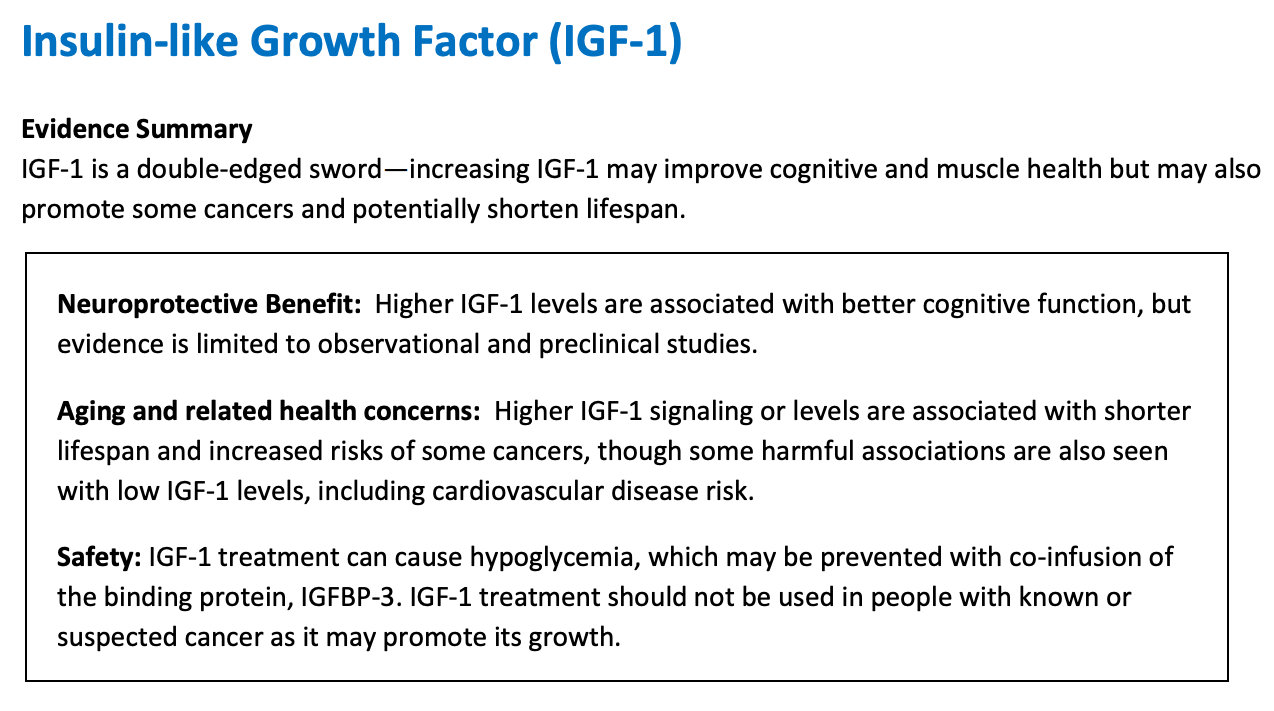
My read of the literature agrees with the above conclusion from ADDF neuroscientists. The observational nature of the human studies (as opposed to a randomized control study) means that lower IGF1 levels in Alzheimer’s could be a compensation for the disease instead of a causal factor. We would need to treat people with Alzheimer’s or people at high risk for Alzheimer’s with IGF1 and demonstrate whether it decreases the risk or progression of Alzheimer’s. This study hasn’t been done and may not be safe to do given the association of higher IGF1 levels with cancer risk.
I would add that mice are notoriously bad models for Alzheimer’s and directionality of expression of RNA is often backwards in mice vs. human in the brain. I always read mouse studies for neurological disorders with a hefty grain of salt when drawing conclusions for humans.
Biology is complicated and we do not yet fully understand IGF1 signaling and its implications for healthspan and lifespan in humans despite it being one of the most studied genes in longevity.
IGF1 therapeutics in humans
There have been over 180 trials between 2003 and 2021 of IGF1R inhibitors, mostly antibodies for various cancers as an indication. Only one has been approved by the US FDA, Teprotumumab, for treating thyroid eye disease.
Challenges with the IGF1R inhibitor cancer trials that have prevented approval:
Biomarker Challenges: Identifying predictive biomarkers to select patients who will benefit has been difficult, with some studies showing that patients with high free IGF-1 might do better.
Toxicity Concerns: Early trials for some agents like Figitumumab and Dalotozumab were associated with increased early deaths and high toxicity rates, leading to termination.
Complex Signaling: The receptor's homology with the insulin receptor can lead to off-target effects and other complex signaling interactions, complicating drug development.
IGF1 therapeutics in dogs
Loyal, a biotech aimed at creating lifespan extending therapeutics for dog companion animals is testing an IGF1 inhibitor in dog clinical trials. The goal of the company is to first create a companion animal therapeutic for the veterinary market and then have a faster route to approval in human beings given the robust animal data.
Loyal is also interested in convincing the US FDA to recognize normal aging as an indication for therapeutic development so that anti-aging drugs have a pathway for approval. Currently drugs aimed at aging must first be approved for an age-related disease. The FDA greenlighting their clinical trial with lifespan as an indication is the first ever longevity clinical trial in the US and ground breaking. Loyal is hoping that this will open the door for human longevity clinical trials.
Dog biology is more similar to humans than mice biology is to humans, especially when it comes to neurological disorders. If Loyal tests cancer and dementia endpoints in their dog trial, we may have more information about what an IGF1 inhibitor would do for human Alzheimer’s and cancer risk. It could pave the way for IGF1 inhibitor human trials with less risk and more clarity.
Summary
The IGF1 signaling pathway is one of the most studied longevity pathways in biology. It links caloric intake with health and lifespan. Reduced IGF1/IGF1R is associated with increased lifespan and decreased risk of neurodegenerative diseases in worms, flies, and mice.
In humans, a rare genetic IGF1R variant is associated with living to 110 years of age or longer. This variant reduces expression of IGF1R in cell culture. From there, the story gets murkier, less IGF1R is associated with less risk of cancer as you might expect but it is associated with increased risk of Alzheimer’s, in contrast to the Alzheimer’s mouse studies. The human studies are not as rigorous as would be ideal, however, and do not tease apart correlation from causation.
>180 IGFR1 inhibitors have gone through clinical trials mostly for various cancers. Only one has been approved for thyroid eye disease. Side effects, off target effects, and patient segmentation/biomarker problems have plagued these trials. Patient segmentation with better biomarkers is one problem NeuroAge is tackling by tracking and characterizing people over time to enable better personalized therapeutics. Loyal hopes to have the first longevity drug approved in dogs, a small molecule inhibiting IGF1.
Should you try to reduce your IGF1 levels?
It might be a bit early for that given the conflicting human trials. Eating a balanced diet with appropriate caloric intake to maintain a healthy BMI is certainly beneficial. Stay tuned for how the IGF1 therapeutic clinical trials continue to play out and for better biomarkers that can personalize these drugs for the individuals they will work for.


Written by
Dr. Christin Glorioso, MD PhD
Dr. Glorioso is the founder and CEO of NeuroAge Therapeutics. With her background in neuroscience and medicine, she is dedicated to revolutionizing brain health and helping people maintain cognitive vitality.
Learn more about Dr. Glorioso

