

The Enhanced Games sold superhuman performance that never was going to happen
A closer look at the first Enhanced Games, as the FDA moves to loosen access to popular peptides
 Dr. Christin Glorioso, MD PhD11 min read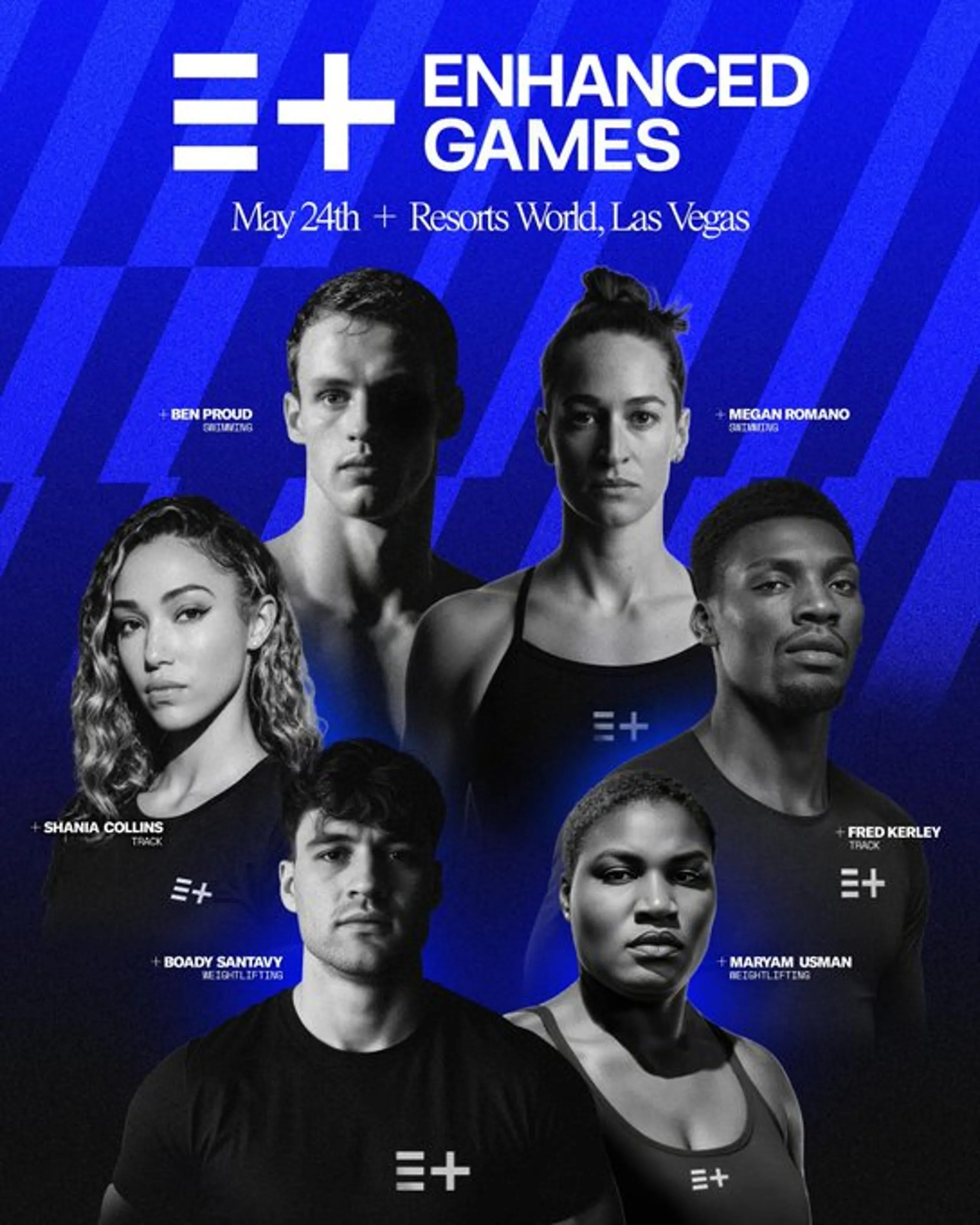
On May 24, 2026, a pro-doping sports event in Las Vegas set out to break world records by removing anti-doping rules and letting athletes use performance-enhancing substances under medical supervision. The Enhanced Games sold spectators on the promise of faster and stronger athletes than the Olympics produces. Across 23 events in swimming, sprinting, and weightlifting, one world record fell and three of the event winners said they competed without any drugs at all. The outcome functions as a rough natural experiment, and the result lines up with what controlled studies of these substances already show.
The event was the work of Enhanced Group, a company founded in 2023 by the Australian lawyer Dr. Aron D’Souza, the German biotech investor Christian Angermayer, and Maximilian Martin, who now runs it as CEO. Their stated aim was to challenge the anti-doping system that governs Olympic sport, on the argument that supervised and disclosed enhancement is safer than hidden use and that athletes should be free to choose it. The competition was also built as the marketing engine for a consumer business selling hormone therapy, supplements, and other performance and longevity products. Weeks before the first Games, the company went public by merging with a blank-check shell company, a route known as a SPAC, at a valuation of roughly $1.2 billion, with more than $1 billion raised from investors including Peter Thiel, Angermayer’s own investment group, and Donald Trump Jr.’s 1789 Capital.
The results. The event paid $250,000 to each winner and offered a $1 million bonus for anyone who beat a recognized world record. Only one athlete triggered it. Greek swimmer Kristian Gkolomeev finished the men’s 50m freestyle in 20.81 seconds, 0.07 seconds under the standing mark. Two details temper that number. The first is that he wore a high-technology swimsuit that governing bodies ban from sanctioned competition. That is equipment rather than a drug, so even the event’s one record cannot be credited to the substances the athletes took. Such suits are prohibited because they make swimmers faster on their own. In the late 2000s they contributed to a run of world records, with 25 set at the 2008 Olympics before the suits were banned. The second detail is that he had already posted a comparable time in a demonstration swim the year before. No federation recognizes the result as an official record.
The clean winners. Three of the event’s winners said they used no performance-enhancing substances. Fred Kerley won the men’s 100m in 9.97 seconds, a time slower than his own personal best. Tristan Evelyn won the women’s 100m in 11.25 seconds, inside the field but outside her career best. Hunter Armstrong won the men’s 50m backstroke. Both sprinters submitted to anti-doping testing before the event to document their status, in part to protect their eligibility for sanctioned competition. For an event built on the premise that chemistry produces winners, having drug-free athletes take the top spot in the marquee sprints ran against the central claim.
How the rest of the field finished. Forty-two athletes from 24 countries competed across the 23 events. Nearly all were enhanced, so enhanced athletes winning roughly twenty of the events was close to guaranteed by the makeup of the field and says little about whether the drugs worked. With about nine in ten competitors enhanced, a near-sweep is what no effect would look like. The four clean athletes were under 10 percent of the field and entered only a handful of events, yet they won three of them, including both 100m finals. Under the assumption that enhancement did nothing and every finalist was equally likely to win, the expected number of clean wins was well under one, and they got three. On the enhanced side, Cody Miller won both breaststroke races and Ben Proud won the 50m butterfly, all at times a strong swimmer can post at a sanctioned meet. In the strength events, Hafthor Bjornsson won the deadlift at 475 kg, though both he and Mitchell Hooper failed their attempts at the all-time record of 510 kg. James Magnussen, the first prominent athlete to sign on and to pledge that he would use enhancers, finished last in the 100m freestyle final. The organizers reported that 12 athletes beat personal bests, which also means most of the roughly 38 who enhanced did not.
What the athletes actually took. Athletes who chose to enhance received a regimen built by the event’s medical staff, chosen from approved categories that covered testosterone and other anabolic steroids, growth hormone, stimulants, and a set of supporting drugs used to manage hormones and side effects. The registered protocol listed the specific agents available, among them several forms of injectable testosterone, the anabolic steroids methenolone and nandrolone, the wakefulness drug modafinil, darbepoetin, which is a long-acting form of the red-blood-cell drug EPO, and hormone-support medications such as clomiphene and thyroid hormone, alongside beta-blockers and diuretics. Peptides on the banned list were left out. Most athletes ran a cycle of roughly three months and several described their doses as moderate rather than the extreme regimens the concept might bring to mind.
The company released aggregate usage figures from the study. They describe the doping athletes rather than the full field. Most of those athletes used several substances at once.
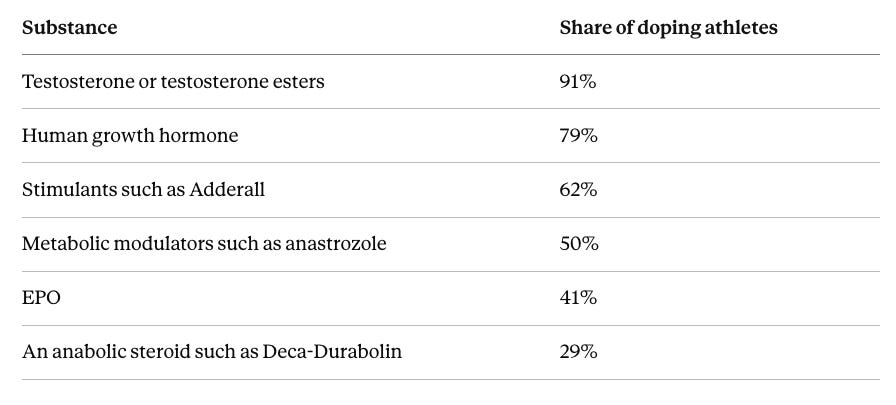
The doping athletes were a subset of a field that also included a small number who competed clean.
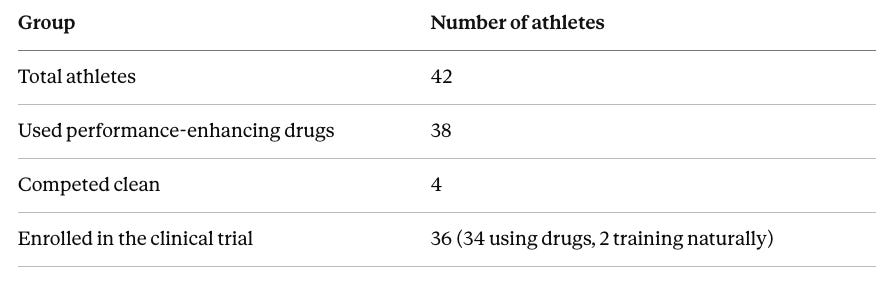
These figures are the organizers’ self-reported aggregate. Individual protocols were not disclosed, so they represent the company’s account rather than an independently verified measurement.
Testosterone does have a real effect. Of the substances used at the event, testosterone and the anabolic steroids have a well-replicated effect on muscle and strength. In a controlled trial published in the New England Journal of Medicine, Dr. Shalender Bhasin and colleagues gave healthy young men either testosterone or placebo for ten weeks, with or without a strength-training program (Bhasin and colleagues, 1996). The men who received testosterone gained muscle size and strength even without training and those who both took testosterone and trained gained the most. So testosterone does help and it helps most in events that reward strength and power. The gain is real but bounded. At the level of a finished competitive mark it comes to a few percent, which is not enough to lift a retired or second-tier athlete to a record set by someone who was already at the physiological ceiling. The strength events were where these drugs should have mattered most and no records fell there.
Growth hormone, widely used and thinly supported. Growth hormone was the second most common choice and its case for events like these is weak. In a randomized controlled trial, Dr. Udo Meinhardt and colleagues found that growth hormone improved sprint capacity on a stationary bicycle but did not improve strength, power, or aerobic fitness (Meinhardt and colleagues, 2010). Much of the lean mass it added was fluid rather than muscle and the effect faded within weeks of stopping. A systematic review of the randomized trials by Dr. Hau Liu and colleagues reached the same view, that growth hormone changes body composition but does little for strength or exercise capacity while raising the frequency of tissue swelling and fatigue (Liu and colleagues, 2008). Stimulants such as modafinil and amphetamines can raise alertness and shorten reaction time, which offers a small advantage at a sprint start without changing an athlete’s top speed.
The parts of performance a hormone does not supply. Sprinting and swimming reward more than muscle mass. They depend on neuromuscular coordination and technique built over years of sport-specific training and these are the components of performance that can’t be created simply by taking a hormone. Adding muscle to an athlete who has not built the skill and the conditioning does not close the gap to the fastest humans, who combine rare genetics with a decade or more of dedicated training. Many of the contested events were short sprints and single lifts that last only seconds, where endurance contributes little, so the red-blood-cell drugs had less to act on. The enhanced athletes also prepared over a compressed window, which organizers cited as one reason the times came in below their projections.
Why the records were improbable from the start. Beyond the pharmacology, the record-breaking premise faced a problem of base rates. Records are rare even at the Olympics. At the 2024 Paris Games, with elite, in-prime athletes competing under favorable conditions, only 19 senior world records were set across seven sports combined and in the pool only four of 35 events produced a world record. Records also tend to fall to the athlete who already holds them or ranks first in the world, not to a challenger arriving from behind. The two records the event singled out for its record bonuses, the men’s 100m and the men’s 50m freestyle, had stood for years and no one has broken the 100m mark since 2009. The Enhanced field was mostly retired Olympians and second-tier finalists, which by definition means not the current record holders, so asking that group to break records that current champions have not touched was a mismatch regardless of any drug. Even the organizers’ own materials projected a gain of only about one to two percent from optimal enhancement, which does not close that kind of gap.
The bottom line. The organizers have said the event will return, so we should see additional answers next year should they chose to modify the event. On the narrow scientific question the first edition posed, whether removing anti-doping rules would produce a visible leap in human performance, no leap appeared. At the level of competitive performance, the controlled literature puts the real effects of these drugs at only a few percent. The event itself could not demonstrate even that, since it had no control group and many of the enhanced athletes did not beat their own past bests. What decided most of the outcomes was current athletic quality and the trained base rather than the substances that athletes took.
The stock reaction. Enhanced Group went public on May 8, 2026 through the SPAC merger at a roughly $1.2 billion projected valuation. After the May 24 event, shares fell about 43% to $3.03 on May 26, closing at an all-time low, as the debut was hit by technical problems and questions over its only world-record performance. It has kept sliding since. As of mid-July 2026 the stock was around $2.63 with a market cap near $333 million, which is down roughly 70% from the deal valuation. The company is loss-making, with trailing twelve-month net income of about negative $26.7 million and negative operating cash flow. One analyst summary captured the mood, that controversy boosted the audience but only one world record was broken, and at a market cap in the mid-$300 millions the market is skeptical of the company’s success.
A step toward looser access. The business the Games exist to promote runs on selling peptides and hormones directly to consumers, so it is exposed to how regulators treat those compounds. On July 23 and 24, 2026, an FDA advisory committee took up seven peptides and recommended six of them, including BPC-157 and TB-500, for the list of substances that compounding pharmacies may prepare against a prescription. It did so over the objections of the FDA's own scientists, who had found the human safety and efficacy data thin. The votes were narrow and non-binding. The agency must still run a formal rulemaking process that will take a year or more, so nothing is legal to compound now that was not legal before. Still, the direction favors the market Enhanced is selling into. If the FDA follows the recommendation, the commercial thesis behind the Enhanced Games looks stronger. The same thin human evidence behind these compounds is now part of the regulatory decision too.
My take. If Enhanced runs this again and wants the results to mean anything, the design has to change. The enhanced and non-enhanced athletes would need to be in balanced groups, matched on ability and equal in number, competing head to head in the same events. That is what a randomized controlled trial does. It is the only way to separate what the drugs contributed from who happened to show up. This year’s field, nearly all enhanced and self-selected, cannot answer the question the event keeps posing. A real comparison would either show the drug effect clearly or confirm how small it is. Either result would be more useful than another night of marks that no one can interpret.
And next year, we may see new peptides added to the mix?


Written by
Dr. Christin Glorioso, MD PhD
Dr. Glorioso is the founder and CEO of NeuroAge Therapeutics. With her background in neuroscience and medicine, she is dedicated to revolutionizing brain health and helping people maintain cognitive vitality.
Learn more about Dr. Glorioso

