

Does tattoo ink increase cancer risk?
What the latest science says and less risky ink options
 Dr. Christin Glorioso, MD PhD11 min read
I got my first tattoo during the pandemic in 2021 in a beautiful church in Philadelphia at True Hand Society.

It took me a long time to figure out what I wanted. Ultimately, I chose the dinosaurs that live atop the 10th Street bridge in Pittsburgh, where I grew up.


I used to run over that bridge all the time and inexplicably the dinosaurs gave me joy. I think it was the fact that someone took the time to scale hundreds of feet in the air just to put some dinosaurs on a bridge. It was bravery for the sake of whimsy, which is just so Pittsburgh.

It turns out that a lot of people felt that way about the dinosaurs, and when the city decided to paint over them, thousands of people signed a petition to keep them. The artist who spray painted them was a teenage Tim Kaulen and the dinosaurs were an homage to his grandfather’s duck decoys in his front yard. So they weren’t just whimsy but also about family. Tim is now a photographer at CMU and makes much of the street art and sculptures around Pittsburgh. The dinos are back atop the bridge, commissioned by the city and repainted by Tim, but I still like the originals better.
I got them as a tattoo because it reminds me of Pittsburgh and my roots, and particularly, 1990s Pittsburgh. A special place and time, full of art and debauchery.
I’m currently contemplating flying back to Philadelphia to get my next tattoo in church. So naturally I started to think how tattoo ink might effect my longevity.
I’m in good company. Roughly one in three Americans now has at least one tattoo, and the prevalence reaches 40% or higher in some European countries among adults under 40.
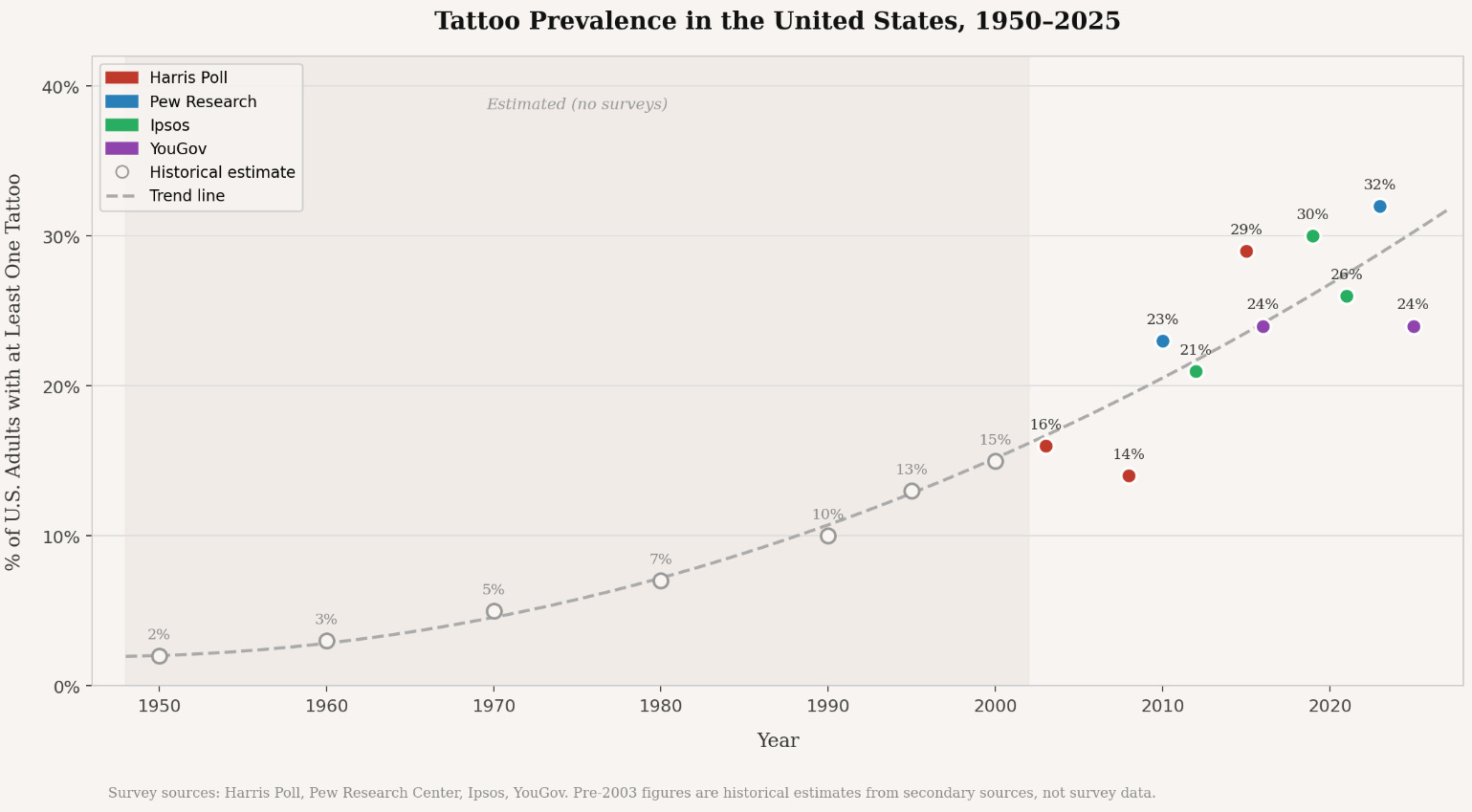
Given that tattooing involves injecting a chemical mixture directly beneath the skin barrier, where it can remain for decades, the question of what those chemicals are and what they do in the body over time is worth looking into.
The scientific literature on this topic has grown in recent years. Several new epidemiological studies on cancer risk appeared since 2024, and post-regulation compliance data from Europe paints a complicated picture. This article reviews what the current evidence shows.
What tattoo ink contains
Tattoo inks are complex chemical mixtures. They consist of pigments (the coloring agents), carrier liquids that keep the pigment evenly distributed and help prevent bacterial contamination, and a range of contaminants and byproducts that are either introduced during manufacturing or produced inside the skin after injection.
A 2022 systematic review published in Human and Experimental Toxicology identified three main categories of concern: 1. polycyclic aromatic hydrocarbons (PAHs), 2. primary aromatic amines (PAAs), and 3. heavy metals. PAHs are a class of chemicals formed during combustion. Benzo(a)pyrene, one of the most studied PAHs, is present in carbon black, the pigment used in most black tattoo inks. PAAs are chemical compounds that can form inside the skin as azo dyes, a common type of synthetic colorant, break down under ultraviolet light or through metabolic processes. Both PAHs and PAAs are classified as probable or confirmed carcinogens by major health agencies.
The heavy metals found in tattoo inks include cadmium, lead, mercury, arsenic, chromium, cobalt, nickel, and copper. These come primarily from the pigment compounds rather than being added intentionally. Cadmium and its compounds are classified as Group 1 carcinogens by the International Agency for Research on Cancer, meaning the evidence that they cause cancer in humans is considered definitive. Mercury, cobalt sulphate, and carbon black fall into Group 2B, meaning they are possibly carcinogenic in humans.
A 2023 analytical study measured metal content across multiple ink brands and colors and found wide variation. Copper concentrations ranged from 1.24 to 2,523.4 mg/kg depending on the sample, and some products exceeded EPA-recommended limits. The ink color and brand were both significant predictors of metal content.
Inks also contain carrier liquids and preservatives. The safest common carriers are ethanol, distilled water, and glycerin. Less safe options that appear in some formulations include formaldehyde, a known carcinogen, as well as ethylene glycol and glutaraldehyde, which are toxic. Some black inks still use bone char, a product derived from burning animal bones, as the carbon pigment source.
How ink moves through the body after injection
The tattooing process places ink in the dermis, the layer of tissue beneath the visible outer surface of the skin. Unlike a wound that heals and clears, the ink does not stay in place. A 2025 study using human skin explants and tattoo needles showed that pigment particles distributed deep into the dermis and accumulated close to blood vessels, suggesting the potential for entry into systemic circulation. The study also found increased expression of interleukin-8, an inflammatory signaling molecule, in tattooed skin, as well as increased markers of cell death.
Multiple earlier studies have confirmed that tattoo pigment particles migrate from the injection site to regional lymph nodes, the small glands of the immune system that filter fluids from surrounding tissues. This migration appears to be driven partly by immune cells that engulf the ink particles and travel toward the lymph nodes. The pigment can remain in the lymph nodes for years, where it continues to interact with immune tissue.
Some PAHs, in particular, can remain in the skin for life. The duration of this exposure is relevant because carcinogenesis, the process by which normal cells transform into cancer cells, typically involves cumulative and long-latency exposures rather than acute ones.
The three recent studies on cancer risk
Three epidemiological studies published since 2024 have found associations between tattooing and cancer risk, primarily lymphoma and melanoma. These constitute the first meaningful population-level evidence in this area.
Swedish case-control study on lymphoma (eClinicalMedicine, 2024). A population-based case-control study identified all incident cases of malignant lymphoma diagnosed between 2007 and 2017 in Sweden in individuals aged 20 to 60, with three matched controls per case. Tattooed individuals had a 21% higher relative risk of lymphoma compared to non-tattooed individuals. The risk pattern over time showed a U-shaped curve: elevated in the first two years after tattooing, declining between years three and ten, then rising again after eleven years.
Danish twin study on lymphoma and skin cancer (BMC Public Health, 2025). A twin-based study used the Danish Twin Registry to study 316 twins in a case-control design and 2,367 twins in a cohort design. In the case-control analysis, tattooed individuals had a 62% higher rate of skin cancer excluding basal cell carcinoma (hazard ratio 1.62, 95% confidence interval 1.08 to 2.41). Among individuals with tattoos larger than the palm of a hand, the hazard ratio for lymphoma was 2.73 and for skin cancer was 2.37. The median time from first tattoo to cancer diagnosis was 8 years for lymphoma and 14 years for skin cancer.
Swedish case-control study on melanoma (European Journal of Epidemiology, 2025). A third study identified 2,880 cutaneous melanoma cases from the Swedish National Cancer Register and found a statistically significant association with tattoo exposure. The authors propose that chronic immune activation from tattoo pigment deposited in lymph nodes may be part of the mechanism.
A contradicting finding also warrants attention. A study published in the Journal of the National Cancer Institute in late 2025 found that individuals with three or more large tattoos had a 74% lower risk of melanoma compared to tattoo-free individuals, which runs directly counter to the Swedish melanoma findings. This discrepancy has not yet been resolved in the literature.
The absolute increase in cancer risk with tattoo ink is small and we aren’t sure if it's causal
The relative risk increases found in these studies, 21% higher for lymphoma and 62% higher for skin cancer, require context to interpret meaningfully.
The baseline annual incidence of lymphoma in the United States is approximately 26 cases per 100,000 people, or about 0.026% of the population per year. A 21% relative increase applied to that baseline brings the rate to roughly 31 per 100,000 per year, an increase of 5 additional cases per 100,000 people annually. For most individuals, this represents a small absolute change in personal risk.
Several methodological limitations matter are worth pointing out in these studies. None of them are randomized controlled trials. Randomizing people to get tattoos or not and following them for decades is not feasible, so all available evidence is observational. Observational studies cannot fully account for all confounders, the other variables that differ between tattooed and non-tattooed populations, including sun exposure, lifestyle factors, occupational exposures, and socioeconomic differences.
Population-level cancer registry data in Nordic countries do not show a rise in non-Hodgkin lymphoma or non-melanoma skin cancer that would be detectable if tattooing were a major driver of incidence at the population level. This does not rule out a real association, but it suggests that if the signal is genuine, the fraction of cancers attributable to tattooing in the current population is small.
The EU REACH regulation and the limits of compliance claims
The EU REACH regulation, which came into full force for most tattoo ink ingredients in January 2022, restricts over 4,000 substances and is the most comprehensive regulatory framework for tattoo ink anywhere in the world. It covers carcinogens, mutagens, reproductive toxins, skin sensitizers, and irritants, and requires accurate full ingredient labeling on packaging.
Post-2022 compliance data show a significant gap between regulatory intent and market reality. A 2024 study in the journal Analyst tested green and blue inks from five manufacturers all claiming REACH compliance and found nine out of ten were non-compliant, with four containing outright banned materials.
A 2024 European enforcement action coordinated across 14 countries analyzed 52 ink samples and found non-compliances in 37 of them. A 2025 study of 41 EU-market inks purchased in 2022 and 2023 found limit exceedances for nickel in 24 samples, arsenic in 20, hexavalent chromium in 16, copper in 10, antimony in 8, cobalt in 6, and lead in 5. Non-cancer risk from copper was modeled as unacceptable in up to 85% of products.
The United States has not implemented an equivalent regulatory framework. The FDA classifies tattoo inks as cosmetics and has not pre-approved any pigments for injection into skin.
Practical steps for reducing exposure
Ask which ink brand and product line your tattoo artist uses and request to see the original bottle. Reputable artists will have this information available. You can also request a Safety Data Sheet, a standardized document listing chemical ingredients and safety information.
Brands with relatively strong safety reputations among professionals include Eternal Ink, World Famous Tattoo Ink, Solid Ink, StarBrite Colors, and Quantum Tattoo Ink. That said, independent analytical testing of specific batches from any brand remains limited, and REACH-compliant labeling alone is not a reliable guarantee of compliance based on current enforcement data.
Color selection matters. Red and yellow inks carry the highest documented risk from azo pigment breakdown products and historically have contained the most problematic heavy metals. Black inks made with carbon black may contain PAHs. Simpler designs using fewer colors and smaller surface areas reduce total ink load and overall chemical exposure.
Ultraviolet light accelerates the breakdown of azo dyes into PAAs inside the skin. Sun protection over tattooed areas with SPF clothing or sunscreen reduces this photochemical degradation, supported by the underlying chemistry even in the absence of definitive long-term outcome data.
Individuals with personal or family history of lymphoma, melanoma, or other immune-related cancers, those with immune system conditions, or those with known sensitivities to heavy metals or dyes may want to discuss the current evidence with a physician before making decisions about new tattoos.
Where the evidence stands
Tattoo ink does contain chemicals with established or plausible toxicity, including carcinogens, heavy metals, and reactive dye compounds. These chemicals do not remain localized at the injection site. They migrate through the body and accumulate in lymph nodes, where they interact with immune tissue over years to decades.
The three recent epidemiological studies represent the first population-level data suggesting a cancer signal. The associations found are biologically plausible, but the absolute risk increases are small in the context of baseline population incidence, the evidence is observational rather than causal, and at least one contradictory finding exists in the literature.
REACH compliance is the best available standard, but current enforcement data show that compliance claims on product labels are not reliably accurate. Regulatory frameworks are improving but uneven, and meaningful independent batch testing of inks remains rare.
My take
Am I going to go to church for my next tattoo? I think so. The absolute cancer risk seems pretty small to me and we aren’t sure that it’s real. I will be asking about dye ingredients though and will be advocating for the least toxic option.


Written by
Dr. Christin Glorioso, MD PhD
Dr. Glorioso is the founder and CEO of NeuroAge Therapeutics. With her background in neuroscience and medicine, she is dedicated to revolutionizing brain health and helping people maintain cognitive vitality.
Learn more about Dr. Glorioso

