

Introducing Younger, a six-month contest to measure and reverse biological aging
 Dr. Christin Glorioso, MD PhD13 min read
Living longer helps only if the added years are healthy ones. The goal aging researchers call compressing morbidity, first laid out by Dr. James Fries in 1980, is to raise the age at which chronic illness begins by more than we raise lifespan, so the stretch of poor health at the end becomes shorter and arrives later. On a survival curve, meaning the fraction of people still alive at each age, this shows up as the curve becoming more rectangular. It stays high through the healthy decades and then falls over a narrower band.
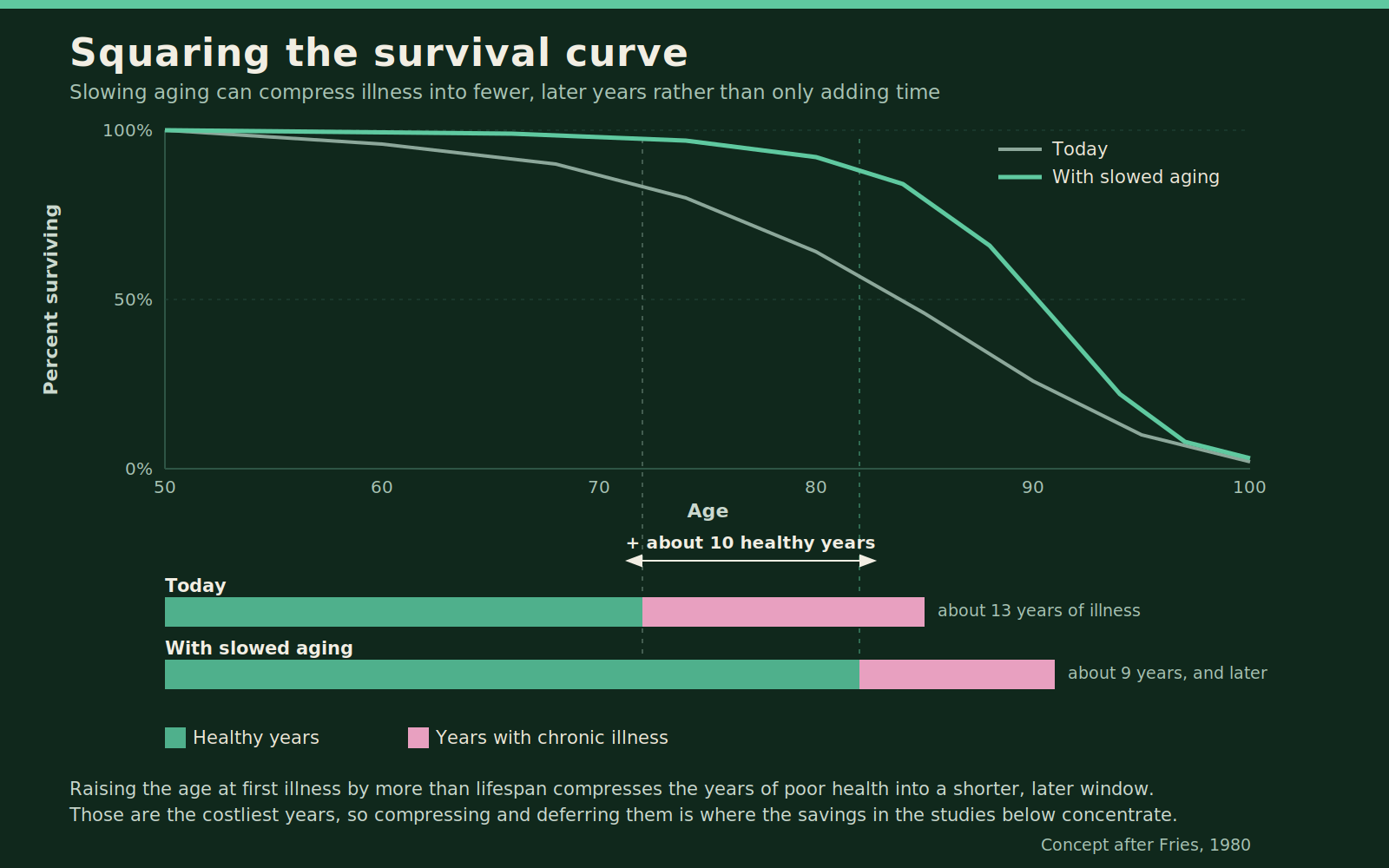
Younger, the six-month contest this article introduces, is fun and shows how cutting-edge science from top universities can be used to slow aging in practice. It is also explicitly a public health project, and the government savings from a shift like this across a whole population runs into the trillions of dollars.
The economics of compressing illness
The value of slowing aging runs into the tens of trillions. In a 2021 analysis in Nature Aging, Dr. Andrew Scott, Dr. Martin Ellison, and Dr. David Sinclair valued a slowdown in aging that adds one year of healthy life expectancy at about 38 trillion dollars to the United States, and ten years at about 367 trillion, with improving health worth more than extending lifespan alone. Using a simulation of older Americans, Dr. Dana Goldman and colleagues estimated in Health Affairs that delayed aging could add about 2.2 years of life, most of it healthy, worth around 7.1 trillion dollars over 50 years.
The savings are clearest in the diseases aging drives, and dementia shows the scale. Dr. Julie Zissimopoulos and colleagues projected that annual United States dementia costs would climb from about 307 billion dollars to 1.5 trillion between 2010 and 2050, with Medicare and Medicaid covering roughly three quarters of the formal cost. Pushing onset back five years would cut dementia prevalence by about 41 percent and add roughly 2.7 years of life per person, most of them free of the disease. Even a single year of delay would save about 219 billion dollars by 2050. A field-wide two-year reduction in biological age, if it reflects real slowing of aging, is a step in that direction, which is what Younger is built to measure.
Biological age has moved from a research idea to something a person can measure at home. Over the past two decades, work across MIT, Harvard, Yale, and other centers has shown that two people born in the same year can differ in how fast their bodies are aging, and that the pace of aging responds to what we do. Younger takes that measurement science and builds a competition around it. Over six months, competitors measure their biological age across brain, body, and face, use the results to guide the health changes they choose to make, then repeat the same measurements to see what changed.
Below is what the contest measures, how each measurement works, the research behind the ones we selected, the full timeline, and the two live events that bracket the six months.
Aging happens at different speeds, and that speed can be measured
People the same age are not the same age biologically. A 2015 study of about a thousand adults, all born in the same year, found their estimated biological age spanned a range of close to two decades. Some 38-year-olds were aging like 28-year-olds, and some like people in their late forties.
Most of that difference is not written in our genes. Classic twin studies place the genetic contribution to human lifespan at roughly a quarter, which leaves most of the variation to environment and behavior. That is the part a person can act on.
The pace of aging predicts later health. DunedinPACE, a DNA methylation measure of how fast someone is aging, has been linked to higher rates of illness, disability, and all-cause mortality in people who are aging faster. DNA methylation refers to chemical tags that sit on DNA and shift in patterned ways across the lifespan, which is what these tests read.
And the pace can move. An 8-week randomized trial of diet, sleep, exercise, and targeted supplements lowered a DNA methylation measure of age by about three years compared with a control group. It was a small early study, and it supports the idea that a person’s biological age can reverse rather than only rise with time.
What Younger measures, and how each measurement works
Younger combines several measurements, each drawn from published aging research. Here is what each one captures, how competitors complete it, and the science behind why we chose it.
Epigenetic biological age from a blood spot. A single dried-blood-spot kit, collected at baseline and again at six months, runs on TruDiagnostic‘s TruAge platform. It reports pace-of-aging and biological-age clocks alongside TruHealth, a clinical biomarker panel covering cholesterol, blood sugar, inflammation markers, and nutrient status. The science behind this measurement is the same DunedinPACE and epigenetic-reversal work described above.
Biological age across organ systems. Organs within one person can age at different rates, so a single number can miss a lot. TruDiagnostic’s SymphonyAge reports biological age across 11 systems, including heart, brain, lung, liver, kidney, and immune, from the same blood sample. The approach comes from a 2025 study in Nature Aging led by Dr. Raghav Sehgal, a Younger scientific partner and Yale faculty member, which built 11 system-specific methylation clocks from one blood draw, each predicting outcomes tied to its own system. A separate 2023 study in Nature using blood proteins found that accelerated aging in a given organ raised the risk of disease in that organ, and that carrying several accelerated organs was associated with 20 to 50 percent higher mortality risk.
Brain age from a cognitive test. Processing speed, memory, and executive function, meaning the brain’s planning and self-control, are among the cognitive abilities most sensitive to brain aging, and NeuroAge’s NeuroGames measures them from a phone in about 30 minutes, self-administered at baseline and again at six months. The two screens most commonly used in a doctor’s office, the Mini-Mental State Examination and the Montreal Cognitive Assessment, were built to detect impairment that is already present, and both are scored out of 30 by a clinician in the room. Healthy adults tend to score at or near the top, so those screens have little room left to show the small, early shifts that matter for someone trying to age well rather than to be diagnosed. NeuroGames instead produces continuous scores across five tests and compares each to age- and sex-matched benchmarks, which can reveal differences that would not appear in a single clinic visit.
The individual tests rest on published work. An online study of more than 75,000 adults found that reaction time, the speed at which the brain takes in and responds to something, starts changing in the third decade of life and tracks many of the same factors that raise dementia risk. An earlier analysis from the same group found that a family history of Alzheimer’s shifted memory performance about four decades before the usual age of diagnosis. NeuroGames also uses a face-name memory test developed by Dr. Dorene Rentz at Harvard, which distinguished people with early Alzheimer’s-related protein buildup from those without it, and a number-span test of working memory, the ability to hold and use information over a few seconds, which one longitudinal analysis found to be the first measure to move while people were still cognitively normal. Testing more than memory matters because a memory-only screen would miss the early cases where the first sign of Alzheimer’s is a non-memory problem, in areas like judgment or language, which is more common in younger patients. The speed-of-processing training in NeuroGames is inspired by the task used in the ACTIVE trial, where that kind of training was linked to up to 30% lower rates of dementia diagnosis in the years that followed.
Face age from a standardized photo. FaceAge is a deep-learning model, developed by Dr. Ray Mak and colleagues at Harvard, that estimates biological age from a face photograph. Competitors capture standardized photos at baseline and at six months. In the model’s 2025 study in The Lancet Digital Health, it was trained on face photos from 58,851 people, and among cancer patients an older face age tracked worse survival. A 2026 study in JAMA Network Open found that in early-stage lung cancer, each decade of higher face age was associated with about 39 percent higher risk of all-cause mortality, while chronological age was not independently associated. Face age also tracked molecular markers of cellular senescence, one of the biological hallmarks of aging.
Functional age from fitness and movement. A handful of physical tests predict long-term health on their own. VO2 max, a measure of how much oxygen the body can use during hard exercise, is captured through a wearable. Grip strength uses a small hand dynamometer included in the kit, and the sit-to-stand test is filmed for verification, all completed at home at baseline and six months. The findings behind each come from large studies.
In a 2018 study of 122,007 adults, cardiorespiratory fitness was inversely related to all-cause mortality with no observed upper limit of benefit.
In the PURE study across 17 countries, each 5-kilogram drop in grip strength was associated with about 16 percent higher all-cause mortality.
In a study of the sitting-rising test, each one-point gain on its 10-point scale was associated with about 21 percent lower all-cause mortality.
I have written more on two of these, in The Science of VO2 Max and Dementia Prevention and on HRV, longevity, and brain health.
The Ultra panel adds brain imaging and pre-release clocks
The standard Competitor panel covers the epigenetic, cognitive, face, and functional measurements above. Ultra Competitors add brain imaging along with several tests that are not yet available to the public, so they are among the first people to use them.
Two brain MRIs. Ultra Competitors receive non-contrast brain MRIs at baseline and retest, at partner imaging centers worldwide, with BrainKey volumetric analysis and a radiologist preventative screening read. The scans measure structures such as the hippocampus, a region central to memory that tends to shrink with age, and the screening read looks for incidental findings a person would want flagged.
Proteomic organ age from Vero Bioscience. Vero is a Stanford spinout co-founded by Dr. Tony Wyss-Coray, whose lab developed the underlying method. From a single blood draw, it reads organ-specific proteins and estimates the biological age of individual organs. In the founding 2023 study in Nature, accelerated aging in an organ raised the risk of disease in that organ, and a later 2025 study in Nature Medicine of about 44,500 people in the UK Biobank linked older organ ages to the later onset of conditions such as heart failure, chronic obstructive pulmonary disease, type 2 diabetes, and Alzheimer’s disease. These proteomic clocks are not on the market yet.
New methylation clocks from Yale. Ultra Competitors also test on methylation-based aging clocks from Dr. Raghav Sehgal’s lab at Yale, ahead of their public release.
The NeuroAge blood test. This is an RNA-based read of brain aging that tracks gene-expression patterns tied to neuroinflammation, cellular stress, and mitochondrial function. RNA is the working copy the body makes from DNA, and it shifts in response to lifestyle and interventions, so the test is designed to capture change over the six months rather than a fixed baseline. The NeuroAge blood test is an extension of work that Dr. Christin Glorioso published when she was a scientist at MIT.
The timeline
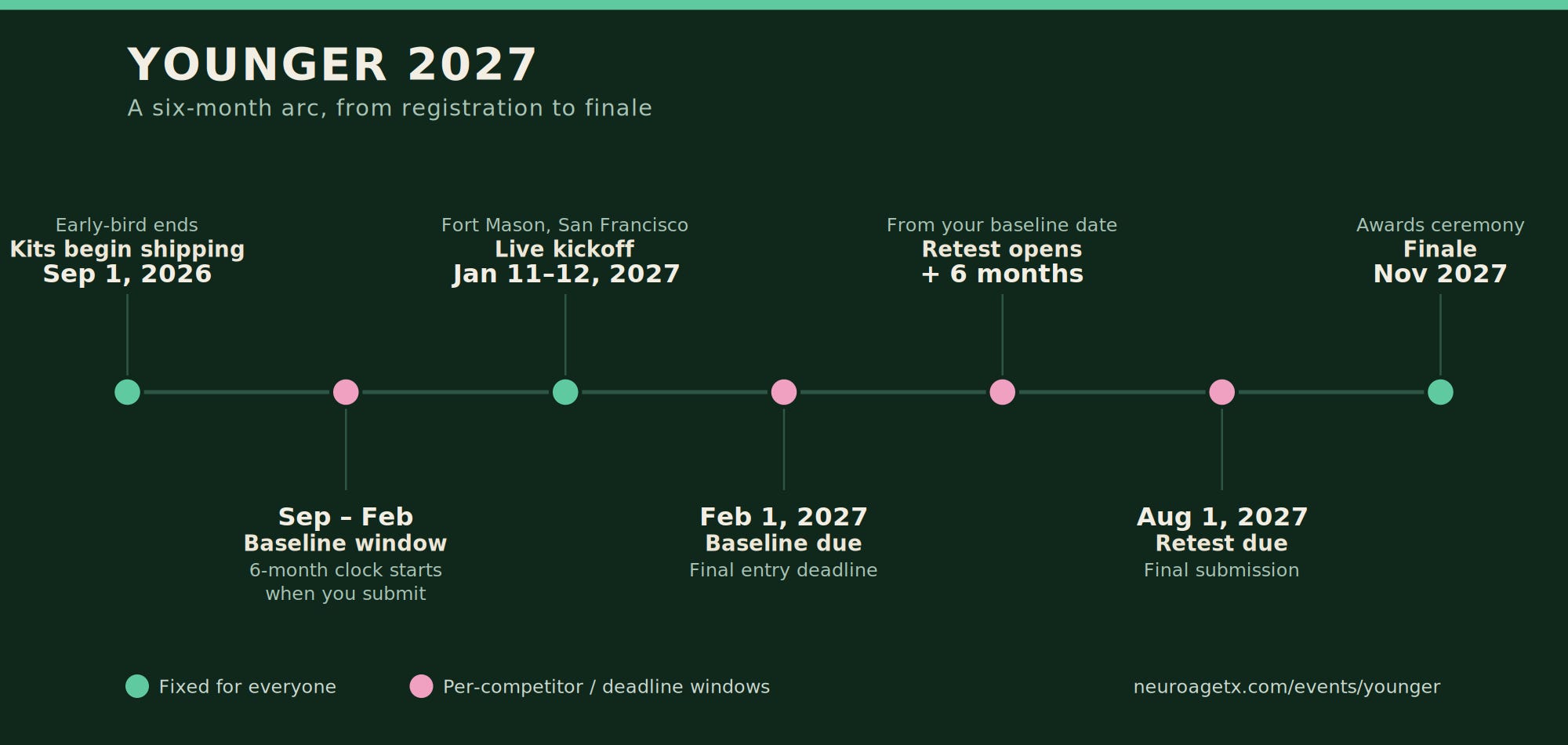
Registration is open now. Baseline kits begin shipping on September 1, 2026, which is also when early-bird pricing ends. Each competitor’s six-month clock starts when they submit their baseline measurements, not on a single shared date, so the schedule is partly personal.
The baseline window runs from September through the start of February, and all baseline measurements are due by February 1, 2027. The live kickoff takes place January 11 and 12, 2027 at Fort Mason in San Francisco, during that baseline window, and most competitors arrive having already done their at-home baseline tests. Retesting opens six months after each competitor’s baseline date, and all final measurements are due by August 1, 2027.
The finale follows in November 2027. The gap between the August retest deadline and the November finale gives the labs time to process samples, review results, and finalize scoring before results are read on stage.
The live events
Kickoff, January 11 and 12, 2027. Both events are held at the Gateway Pavilion at Fort Mason Center, a waterfront venue on the San Francisco Bay. The two-day kickoff brings the full competitor field into one room alongside a longevity expo, workshops, and a keynote stage. Confirmed speakers include Dr. Ray Mak, co-creator of FaceAge, Dr. Raghav Sehgal of Yale, Dr. Steve Horvath, Dr. Eric Verdin of the Buck Institute, and Ryan Smith, founder of TruDiagnostic, among others. It is open to competitors and to the public with a Kickoff Pass.
Finale, November 2027. By November every retest is in and analyzed. The finale is the awards ceremony, with a leaderboard reveal, on-stage interviews with the top finishers, and the announcement of winners. It is open to competitors, spectators, and media.
Headline awards recognize the most years turned back over the six months and the youngest biological age relative to chronological age, with parallel awards on the Ultra panel and additional organ-system categories to be confirmed before kickoff.
Support along the way, and findings shared afterward
Personalized recommendations. Every competitor receives recommendations built from their own results, focused on the areas where their biology has the most room to improve.
An online community. Join a Slack with other competitors to share tips, tactics, and encouragement in your journey to become younger.
A workout class in San Francisco. Competitors in the Bay Area can join an intense workout class tailored to make you younger that meets twice a week in San Francisco. Dr. Glorioso will be there with you. Expect Norwegian 4X4s, box jumps, pull ups and dead hangs.
A discount package. A package of savings from our partners who provide services and products like yoga classes and sauna to help you on your journey.
Monthly webinars. Through the six months, monthly webinars introduce practical tricks and tactics for slowing aging.
Findings shared afterward. When the contest closes, NeuroAge will publish the results with all data anonymized, so competitors and readers can see what worked for the people who improved the most.
How to take part
A single entry covers either the in-person track in San Francisco or a virtual track, at the same price and with the same testing, data, and prize eligibility, so competitors can take part from anywhere in the world. Because that entry bundles tests from several partners into one package, the price is well below what the same tests would cost bought one at a time. There is a Competitor tier and an Ultra Competitor tier that adds the brain MRIs and the pre-release clocks described above. Full details, tiers, and the published biomarker list are on the Younger page. NeuroAge is also hosting a live online information session on Zoom ahead of baseline testing, where the teams behind each test explain how the assessments work and answer questions. Details for that webinar are on Luma. Registration for the contest itself is open now on Luma.
This contest is like dry January on steroids. Are you ready to see how much #younger you can get?


Written by
Dr. Christin Glorioso, MD PhD
Dr. Glorioso is the founder and CEO of NeuroAge Therapeutics. With her background in neuroscience and medicine, she is dedicated to revolutionizing brain health and helping people maintain cognitive vitality.
Learn more about Dr. Glorioso

