

How many friends and relationships do you need for a healthy brain?
Relationship types, how many minutes a day, do work colleagues, pets, and AI count
 Dr. Christin Glorioso, MD PhD25 min read
Community is widely accepted as important for longevity and is one of the nine pillars of healthy brain aging at NeuroAge. Most of the advice on community simply says “friends are good” and stops there. I wanted to know how many relationships, how often to see them, and for how many minutes, counting not only friends but romantic partners, family, pets, and AI companions. I need the detailed recommendations for my own protocol and for the advice I give people competing in the Younger biological age contest.
The literature is messy and incomplete. This article is my best attempt at synthesizing it into actionable advice anyway.
If you want to skip the science review, scroll to the end for the bottom line and a sample week of optimal social connection.
TL/DR: at least 45 mins a day with varied types of human (not AI) connections is optimal, spouses are only good if your relationship is good, we have no data on romantic partners you are not married to, friends are more important than relatives, video chat is likely ok, pets are only helpful in the absence of people.
Lacking social connection is said to carry a mortality risk like smoking 15 cigarettes a day
The claim shows up frequently on longevity blogs and podcasts. Dr. Julianne Holt-Lunstad and colleagues, whose 2010 meta-analysis is the source, keep a page explaining the comparison. They compared the odds ratio to other risk factors, with each comparison effect drawn from a separate meta-analysis and the smoking figure taken from a 2008 analysis in the Journal of Insurance Medicine.
People with stronger social relationships are said to have a 50% higher likelihood of survival. That figure comes from the same paper, which pooled 148 studies covering 308,849 people followed for an average of 7.5 years into an odds ratio of 1.50.
Both numbers get repeated often but neither tells you what to do on a given week. What is a stronger relationship, which relationships count, and how much time do they take? The rest of this article works toward those answers.
What counts as “stronger” social relationships? Each of the 148 studies answered the question differently. The paper specified that where a study reported more than one comparison, the authors took the one with the greatest contrast between high and low, as that study defined high and low. Some compared the top of a network inventory against the bottom, some compared married against unmarried, some used a loneliness scale. The odds ratios going into that average ranged from 0.77 to 6.50, and 81% of the variation between studies was more than chance would produce, which is a formal way of saying the studies were not measuring the same thing.
So the 50% figure does not itself refer to a number of friends. Some of the studies feeding it did count people but the pooled 1.50 averages measures that have no common unit.
The size of the effect depends on how each study measured social connection. This is a modified version of their Table 4. The paper reports the difference across measurement types at p<0.001, meaning the measures predict survival at reliably different magnitudes.
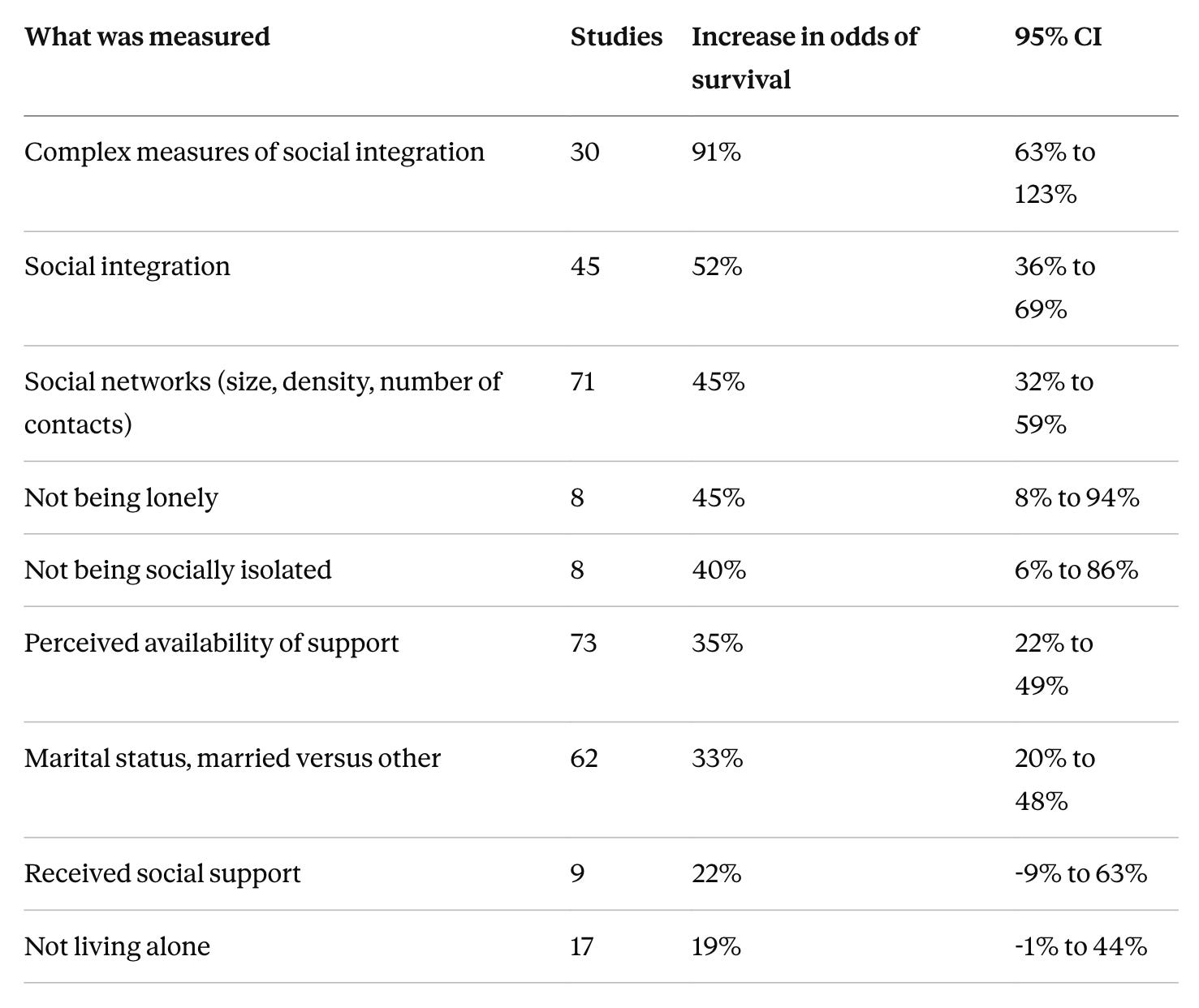
Two of those ranges extend below zero, to -9% and -1%. Received social support, meaning people actually providing help, did not reach significance across nine studies. Neither did living arrangement across seventeen. The measure at 91% is the composite that counts several kinds of tie at once and the paper’s own explanation is that a single item such as living alone fails as a proxy because a person can live alone and have a large supportive network.
The difference between 91% and 19% is the difference between counting how many kinds of tie a person holds and counting who lives in their house, and the first predicts roughly five times as much as the second.
Variety of connection predicts more than sheer number of people
The effect size in that table swung from 91% to 19% depending on how each study measured connection, so the measure matters as much as the finding. The composite that scored highest counted kinds of tie, and one of the standard tools for doing that is the Social Network Index. Its questions are the closest thing the literature has to an answer for how many relationships and how often. Two different questionnaires carry the name, and they answer those questions differently.
A Social Network Index scores how connected a person is by totaling their ties. The first came out of the Alameda County study, where Dr. Lisa Berkman and Dr. S. Leonard Syme built it in 1979 and followed 6,928 adults for nine years, scoring four domains. People with poor social relations had roughly two- to three-fold higher mortality regardless of health status, smoking, drinking, weight, activity, or income.
Their version scores four things, zero or one each, for a total of zero to four. As scored in the Framingham cohort, the four domains each score zero or one.
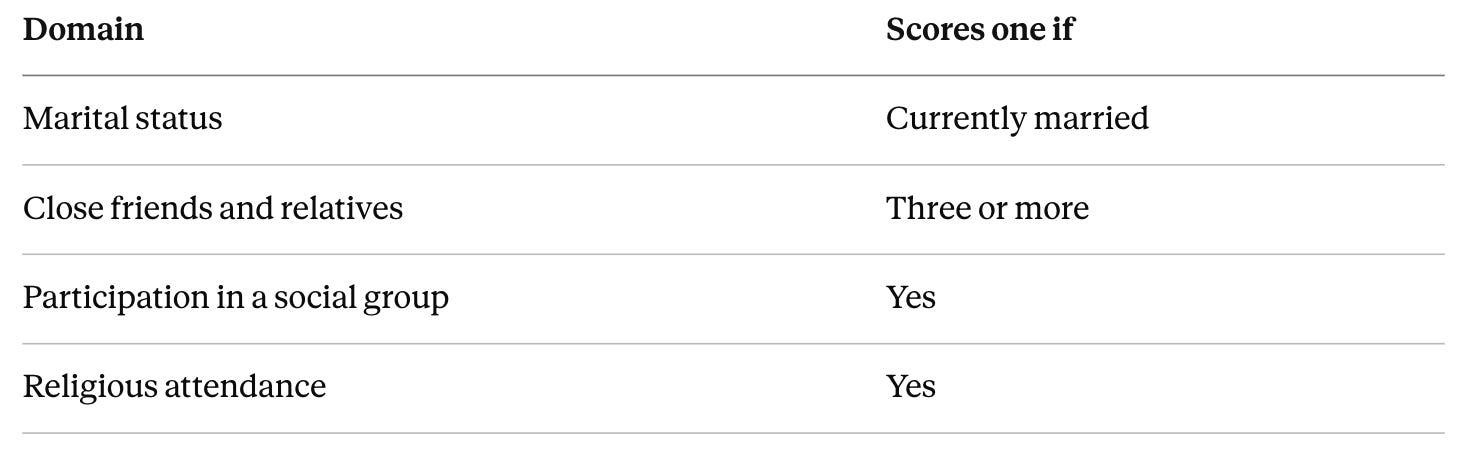
The second domain scores one point at three or more close friends or relatives. The cutoff is a scoring convention rather than a tested threshold.
Half of that index has no frequency information. The two group domains are membership questions. Belonging to a congregation scores the point whether attendance is weekly or annual. For an index whose composite form predicts a 91% increase in odds of survival, two of its four domains cannot distinguish an active member from a name on a list.
A second instrument with the same name fixed that issue. Dr. Sheldon Cohen’s version assesses participation in 12 types of social relationship and a role scores one point only if the respondent speaks with someone in that relationship, in person or by phone, at least once every two weeks. The total ranges from zero to 12.
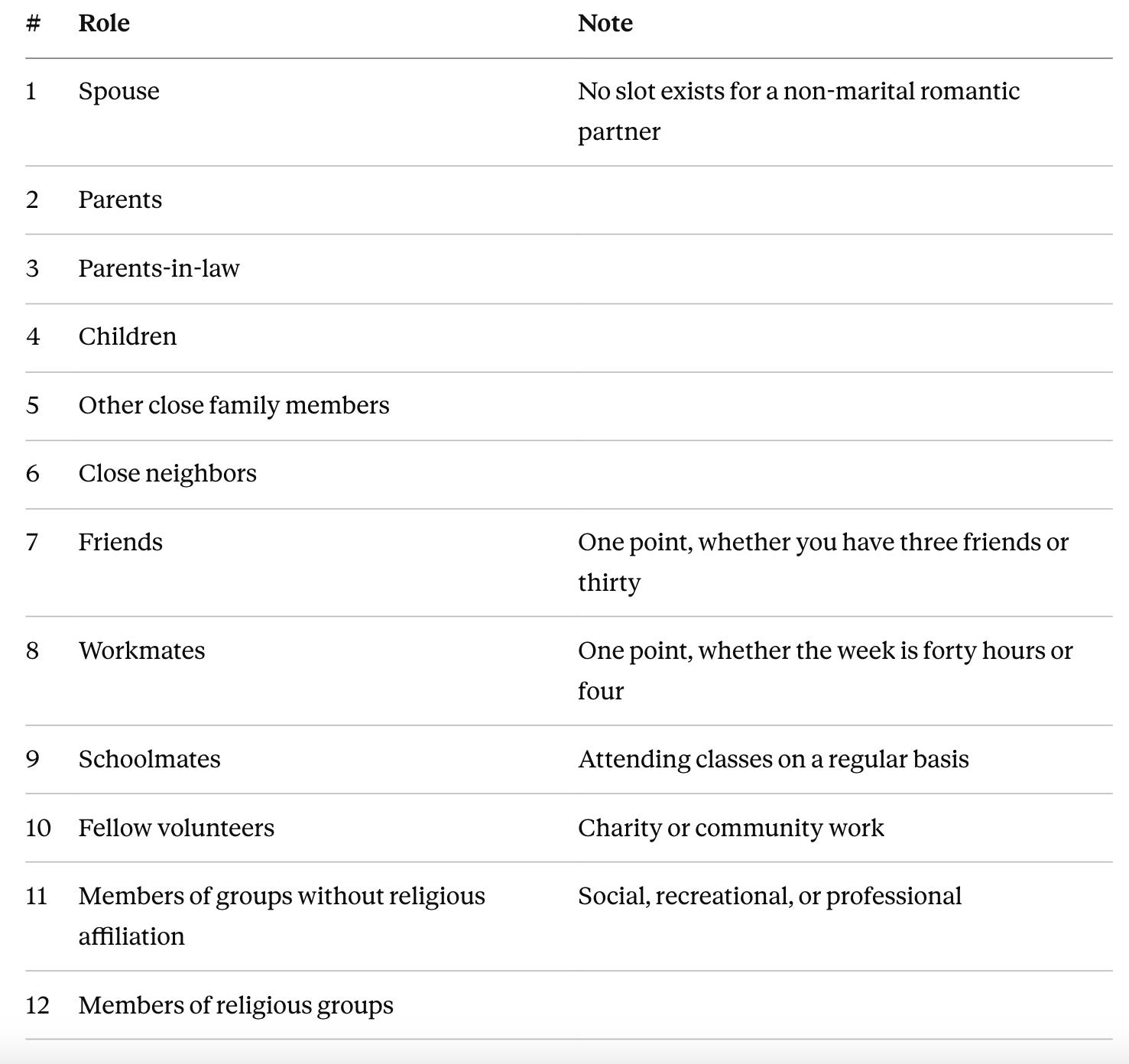
Membership is explicitly not enough. The scoring documentation makes the point with the parent role. Reporting that you have children is necessary but not sufficient. To be assigned the role you must see or speak with at least one child at least once every two weeks. A group you belong to and never attend scores zero.
That threshold is the only frequency requirement attached to group membership in these instruments.
Cohen’s index was validated against the chances of catching a cold. In 1997 he and colleagues had 276 healthy volunteers aged 18 to 55 report their participation in the 12 role types, then gave them nasal drops containing a rhinovirus, quarantined them, and monitored who developed a cold. People reporting one to three role types had 4.2 times the risk of a cold compared with those reporting six or more, with susceptibility falling steadily as diversity rose. The association held after adjustment for pre-existing antibodies, virus type, age, sex, season, body mass index, education, and race.
Diversity predicted susceptibility better than the total number of people in the network did, independently of network size. Holt-Lunstad’s Table 4 shows the same shape against mortality, with composite measures at 91% against network size measures at 45%. The finding holds whether the outcome is a cold or mortality. Variety of connection predicts more than volume of it.
Five of the twelve roles are family ties. They are spouse, parents, parents-in-law, children, and other close family. Someone with no living parents, no in-laws, and no children is capped at nine before doing anything else. The score therefore partly reflects which relatives happen to be alive, which is partly a function of the respondent’s own age. Parents and parents-in-law leave the index as a person ages, as can a spouse through widowhood. Age also predicts mortality and dementia, so an unadjusted association between this index and either outcome would be partly age measuring itself. Cohen’s cold study adjusted for age and the association held, in a sample aged 18 to 55 where most parents are still living. Whether it holds in cohorts old enough for the family roles to be dropping out is a separate question.
Role variety partly measures structural range. A life spread across work, neighbors, a club, and family scores higher than a life with fewer kinds of relationship, regardless of whether anyone in it is close to anyone. A common cutoff treats a score of 4 or greater as a diverse network.
Why would a wider variety of relationships help? Cohen framed the finding through stress buffering, the idea that people embedded in several social worlds have more sources to draw on when one of them goes wrong, so a setback at work or the loss of one relationship lands against a wider base of support. Chronic stress suppresses immune function, and his group read the cold results as diverse ties blunting that effect, since the diversity association survived controls for the health behaviors and personality traits that might otherwise explain it. A different reading is that occupying more roles simply means more total contact and more incidental demands on attention and memory, which is closer to the cognitive-stimulation account that the brain studies later in this article describe. The study measured susceptibility to a cold, not either mechanism, so both remain interpretations of the same association.
No instrument counts a partner you are not married to
Cohen’s twelve roles include spouse and nothing else romantic. Berkman’s partnership domain is married versus not. So dating scores zero on both unless that person independently qualifies as a friend and Whitehall’s wording is the only partial exception, since it asks about friends or acquaintances and an acquaintance is a wide enough category to include dating.
The instruments were written in 1979, 1985, and 1997, and they encode a marriage-or-nothing model. Cohabitation got retrofitted later, which is why Dr. Sommerlad’s meta-analysis pools married and cohabiting as one category. Dating never got a category at all. A 19-year German study noted that most research examines marital status rather than relationship status and that nobody had separately examined dating, cohabitation, and marriage even for physical activity. The one 5-year mortality analysis that looked across spouses, cohabiting partners, and romantic partners found quality more salient than the type of intimate relationship and flagged its own romantic subgroup as very small.
If dating is real social contact and no index counts it, some well-connected people are in the low-exposure group, which biases the measured effects toward the null. Holt-Lunstad makes the same argument about her own 1.50, noting it may be conservative because many studies used single-item measures and most ignored relationship quality.
The only trial with a duration used 30 minutes, four times a week
So far the measures have answered who counts, how many social connections, and how often to see them, but not how long of a social visit is required. If an hour a day is the recommended, an hour of what, and does thirty minutes do the same work as ninety?
Exactly one study attaches a number of minutes to a cognitive outcome, and even it did not test duration, since the researchers fixed the length at 30 minutes and never compared it against a shorter or longer conversation.
Dr. Hiroko Dodge’s group built the intervention. A 6-week pilot used 30-minute video conversations five days a week. That scaled into I-CONECT, a 186-participant randomized trial in socially isolated adults 75 and older with normal cognition or mild cognitive impairment. The experimental group received 30-minute semistructured conversations with trained interviewers four times a week for six months, then twice a week for six more. Both groups also got a weekly 10-minute phone check-in.
The conversations improved cognition in people who already had mild impairment. Among participants with mild cognitive impairment, scores on the Montreal Cognitive Assessment, a standard 30-point cognitive screening test, were 1.75 points higher at six months (p = .03, and an effect size of 0.73, which counts as a medium-to-large difference). Running the age coefficient in their own cohort, the authors calculate that 1.75 points is approximately a decade of age difference in MoCA scores. Among cognitively normal participants there was no effect on the primary outcome (0.14, p = .87). Secondary outcomes showed semantic fluency, a test of how many words in a category someone can produce in a minute, 2.56 points higher in the normal group at six months and story recall 2.19 points higher in the mild cognitive impairment group at twelve, though the multiple-comparison-adjusted threshold was p = .016 and these came in at .03 and .04 so they do not survive correction and the authors advise caution.
The control arm separated frequency from session length. The control group got a 10-minute phone call once a week and reported just as much gain in social satisfaction as the full intervention, with no difference between groups, yet only the four-times-a-week group improved on cognition. So the mood benefit came from a small weekly dose, while the cognitive benefit needed the frequent schedule. That points at how often rather than how long as the active ingredient.
One practical consequence is that total hours are the wrong unit. Eight hours with a friend on Saturday and silence the rest of the week reads as low frequency on every instrument here. It is the concentrated pattern the control arm suggests does less for cognition. Half an hour most days is considered high frequency. An hour a day beats seven hours in one day, according to the best evidence that we have.
The partners were rotated on purpose. I-CONECT deliberately rotated conversation partners to increase novelty and reduce the confounding effect of emotional bonding. And because emotional wellbeing improved equally in both arms, the cognitive gain was demonstrably not mediated by feeling more connected. Brain imaging at rest pointed at the dorsal attention network, the system that directs and holds voluntary attention, rather than at anything emotional, though only 15 participants completed follow-up scans.
The evidence splits on whether close ties or varied ties matter more
One body of evidence points at close friends. The Whitehall II cohort, a 28-year study of British civil servants covered in more detail below, found the protective association specifically in contact with friends, chosen and familiar, and absent for relatives.
I-CONECT says bridging. The authors invoke a distinction between social bonding, meaning family and close friends with emotional attachment inside small units, and social bridging, meaning broader networks of peripheral or irregular ties that generate no particular attachment. Their result supports bridging, since the cognitive gain appeared without any emotional mediation.
Cohen’s roles are closer to bridging than to friendship. Friends, neighbors, and workmates each score one point, so the index rewards structural range across a life more than depth in any part of it, which matches variety outpredicting volume in his own data.
The two findings may not actually conflict, because they measured different things. Whitehall tracked who people already had in their lives over decades and asked what predicted dementia, and there the durable presence of chosen friends had the most signal. I-CONECT added something new to lives that were short of contact and asked what a fresh input could do, and there novelty and mental engagement did the work, whether or not any bond formed. One is about the standing structure of a life, the other about an intervention dropped into it. So closeness may still matter for the connections you keep, while a stranger to talk to may help when the alternative is an empty week. Bonding says invest in a few people. Bridging says add more kinds of contact, with novelty as the candidate active ingredient.
Social contact predicts dementia risk, at about a quarter the size once believed
A cohort with 28 years of follow-up gives a number per standard deviation and then translates it. Dr. Andrew Sommerlad and colleagues followed 10,228 people in the Whitehall II cohort for 28 years, with 463 developing dementia at a mean age of 75.9. More frequent social contact at age 60 was associated with a hazard ratio of 0.88 (0.79 to 0.98) per standard deviation of contact. A hazard ratio is the rate of an outcome in one group against another over time, and a standard deviation is a statistical step size describing how spread out the scores are. At age 50 the figure was 0.92 (0.83 to 1.02) and at 70 it was 0.91 (0.78 to 1.06), neither reaching significance.
One standard deviation is a defined amount here. The authors state that their 12% reduction per standard deviation corresponds to something like the difference between seeing one or two friends every few months and seeing them almost daily.
The exposure was two questions per relationship type.
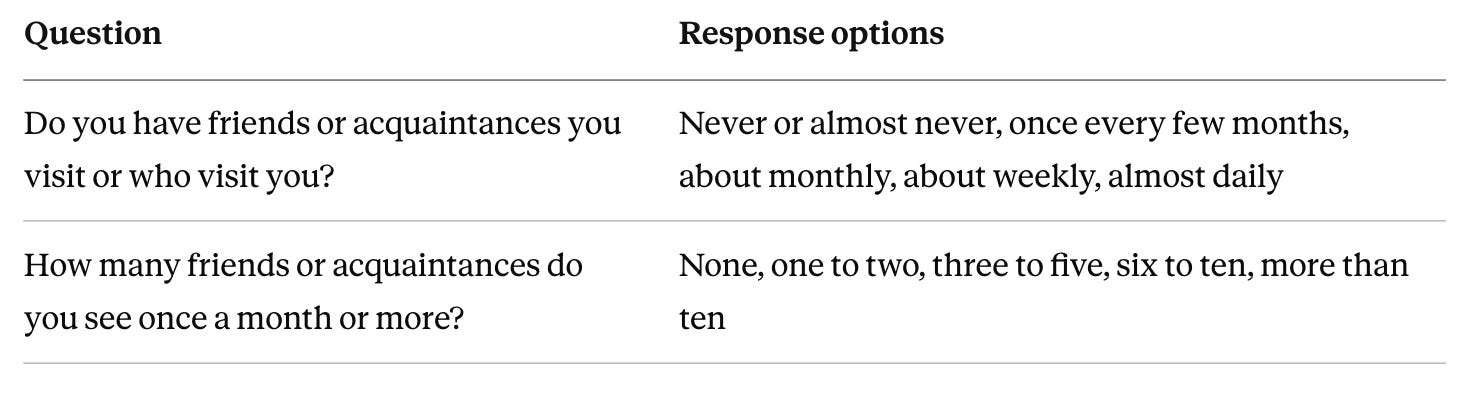
The same two questions covered non-cohabiting relatives. Friends scored zero to eight and relatives zero to eight for a combined range of zero to sixteen, with a mean combined score of 6.9 at age 50, 7.5 at 60, and 8.1 at 70.
The effect is smaller than the field previously believed. Earlier meta-analyses put the high-versus-low contrast at a relative risk near 0.64. One study with under four years of follow-up reported 43% lower dementia risk for daily versus less-than-weekly contact. A Swedish study with three years of follow-up reported 29% lower incidence for daily versus no contact. Whitehall II, with 28 years, found 12% per standard deviation. The authors attribute the gap to reverse causation, since losing contact is an early symptom of dementia and a four-year study partly measures the disease producing the isolation. The 12% figure is the one to use and is about a quarter the size of the number that circulates.
The relationship between marriage and dementia is unresolved. Dr. Sommerlad’s 2018 meta-analysis of 15 studies and 812,047 participants found lifelong single people at a relative risk of 1.42 (1.07 to 1.90) and widowed people at 1.20 (1.02 to 1.41) against married people, with no association for divorced people. Further analysis showed less education partly explained the widowhood risk and worse physical health partly explained the lifelong single risk. An analysis of the National Alzheimer’s Coordinating Center over 18 years found the reverse, with widowed at a hazard ratio of 0.73 (0.67 to 0.79), divorced at 0.66 (0.59 to 0.73), and never married at 0.60 (0.52 to 0.71), all pointing toward lower risk than married people. That cohort is clinic-referred rather than population-based and ascertainment bias is possible, since a spouse is the person who notices decline and books the appointment.
Isolation accounts for a defined share of dementia cases. The 2024 Lancet Commission puts 14 modifiable factors at about 45% of dementia burden, with social isolation contributing 4.6% globally. I wrote about how to get people to act on that 45%, where a review of prevention campaigns found that messaging reliably improves knowledge.
Friends predicted brain health and relatives did not
Contact with friends at age 60 gave a hazard ratio of 0.90 (0.81 to 1.00, p = 0.05). Contact with relatives showed no association at any age point. The cognition analysis split the same way, with the top third of social contact scoring 0.07 standard deviations (0.03 to 0.11) above the bottom third on global cognition, a gap that held across 14 years and was driven by friends rather than relatives.
Three caveats apply to that finding. The friend association is exactly at p = 0.05. The cohort is UK civil servants, 89.1% white, 33.1% female, mean age 44.9 at baseline. And the authors flag a ceiling artifact that would push the relatives result toward null on its own, since someone with daily contact with their only relative could score at most 5 of 8 on the relatives subscale. The defensible reading is that friend contact carries the measured signal and that relative contact may be underestimated by the instrument rather than absent in life.
Two mechanisms compete and both are the authors’ hypotheses rather than findings. Keeping up with friends may take more cognitive effort, building the reserve that delays clinical dementia. Or friends reflect choice, which may bring more enjoyment and less stress.
Quality of the partner relationship is important. Dr. Theodore Robles and colleagues pooled 126 studies covering more than 72,000 people and found marital quality associated with physical health at effect sizes the authors describe as comparable in magnitude to the effects of diet and physical activity on clinical endpoints. In the mortality data, a meta-analysis of 7.9 million people found unmarried status associated with higher all-cause mortality, with never married men carrying about 9% greater excess risk than never married women. Marital status and marital quality are different exposures and only the first appears in the survival tables.
Video calls probably count as connection, AI companions probably do not
Video is on the untested side of a 1985 questionnaire. Whitehall II asked about friends you visit or who visit you. Video carries face, voice, timing, and disclosure, all of which beats no contact. It does not carry touch, practical help, or the incidental time of doing something alongside someone. No cohort has run long enough to give video calls a hazard ratio. I-CONECT is at least suggestive here, since its entire intervention was delivered by webcam and moved cognition.
The AI trials are short and the results split by duration. A four-week randomized trial from MIT and OpenAI found participants less lonely on average, with no significant effects from the assigned conditions but found that people who voluntarily used the chatbot more, regardless of condition, showed consistently worse outcomes across loneliness, socializing with real people, emotional dependence, and problematic use. A 21-day randomized trial with 183 people, with its analysis plan filed in advance, comparing daily companion chatbot use against word games found no overall effect on social health, loneliness, or human relationships. Work in the Journal of Consumer Research found momentary reductions in loneliness after use across a week. A study running twelve months reverses the finding, with a longitudinal study of more than 2,000 adults across four Western countries finding increased social chatbot use predicted increased loneliness over time.
Three weeks shows nothing, four weeks shows benefit, twelve months shows harm, and lonely people select into the tool. That pattern resembles the reverse causation problem that inflated the early dementia estimates by a factor of four, which argues for weighting the twelve-month result. There is no mortality data and no dementia data.
The dog mortality benefit fades after adjustment for exercise, and the cognitive benefit reaches significance only in people living alone
Holt-Lunstad’s protocol ruled them out explicitly, excluding studies where the source of social support was nonhuman and naming a pet or a higher power. So the canonical social connection meta-analysis has no pets in it by design.
The separate pet literature produced a number that circulated widely. Dr. Caroline Kramer and colleagues pooled 10 studies covering 3,837,005 participants with 530,515 events over a mean 10.1 years and found dog ownership associated with a 24% risk reduction for all-cause mortality (relative risk 0.76, 0.67 to 0.86), with cardiovascular mortality at 0.69 and, among people with prior coronary events, 0.35 (0.17 to 0.69).
The analyses were not adjusted for confounders, meaning nothing else about dog owners was held constant.
Adjustment removes the association. Dr. Adrian Bauman and colleagues reanalyzed the same studies using adjusted estimates and found a statistically nonsignificant 7% risk reduction. They note that adjusted estimates attenuate or remove the significant associations, that one statistical approach did produce a significant result but was driven by a single Swedish study contributing 92% of all participants, and that their nonsignificant finding is likely closer to the true pooled estimate. A separate meta-analysis of pet ownership and cardiovascular disease found no association with adjusted all-cause mortality (odds ratio 1.01, 0.94 to 1.08), while subgroups retained modest signals, with adjusted cardiovascular mortality at 0.93 (0.86 to 0.99) in the general population and adjusted cardiovascular risk at 0.71 (0.60 to 0.84) among people with established disease.
The confounder is physical activity, since dog owners walk more. Physical activity was a covariate in Whitehall and it belongs in the dog analyses too and when it is included, most of the 24% disappears.
The cognitive data behave differently. Dr. Ciyong Lu and colleagues followed 7,945 adults aged 50 and older in the English Longitudinal Study of Ageing across eight years, with 35% owning pets and 27% living alone. Pet ownership was associated with slower decline in combined verbal cognition, at 0.008 standard deviations per year (0.002 to 0.014). Among people living alone the association was roughly three times larger, at 0.023 (0.011 to 0.035), and among people living with others it did not reach statistical significance. The authors suggest pet ownership might completely offset the association between living alone and faster decline in verbal memory and verbal fluency.
The benefit appears only in the group with the structural gap, which is the same pattern as the steep bottom of every other curve here. It is a small effect on two verbal measures over eight years, with no data on how long anyone owned the pet.
The bottom line
The article collapsed into a few recommendations:
About an hour a day of social contact, counted broadly. Near-daily short contact of around thirty minutes, one in-person meeting most weeks, and a few recurring group settings. Not an hour a day of one-to-one time with a single person.
Spread social contact across days, not all in one. An hour a day is better than seven hours in a single day. The one trial that compared them found the frequent schedule moved cognition while a single weekly contact did not.
Vary who it is with, not just how often. Variety of relationship predicts more than volume. Friends, neighbors, a group, and workmates is better than one relationship seen consistently.
Weight social contact toward friends over relatives. Friends carried the protective dementia signal in the longest cohort.
A good romantic relationship helps, mainly through its quality. Relationship quality tracks physical health at effect sizes one review put on par with diet and exercise, while being partnered on its own barely moves the numbers.
A pet may help if you live alone. People living alone were the one group where the cognitive benefit reached significance, though it rests on a single study of verbal memory. Living with people, on its own, is not established here as protective.
A minimal and an ideal week
Take someone who works a standard week, attends networking events, and goes to the gym.
How that week scores depends on which instrument you pick and the instruments disagree. On Whitehall it scores near the floor, since work meetings are not friends or acquaintances you visit. On Cohen it does better than that, because workmates is one of the twelve roles, a gym class with anyone you talk to counts under recreational groups, and neighbors may count. Three or four out of twelve is plausible, which reaches the usual bar for a diverse network. On Berkman it scores around 1 or 2 of 4.
Work is counted and capped at one twelfth, no matter how many colleagues or how many hours.
The minimal week
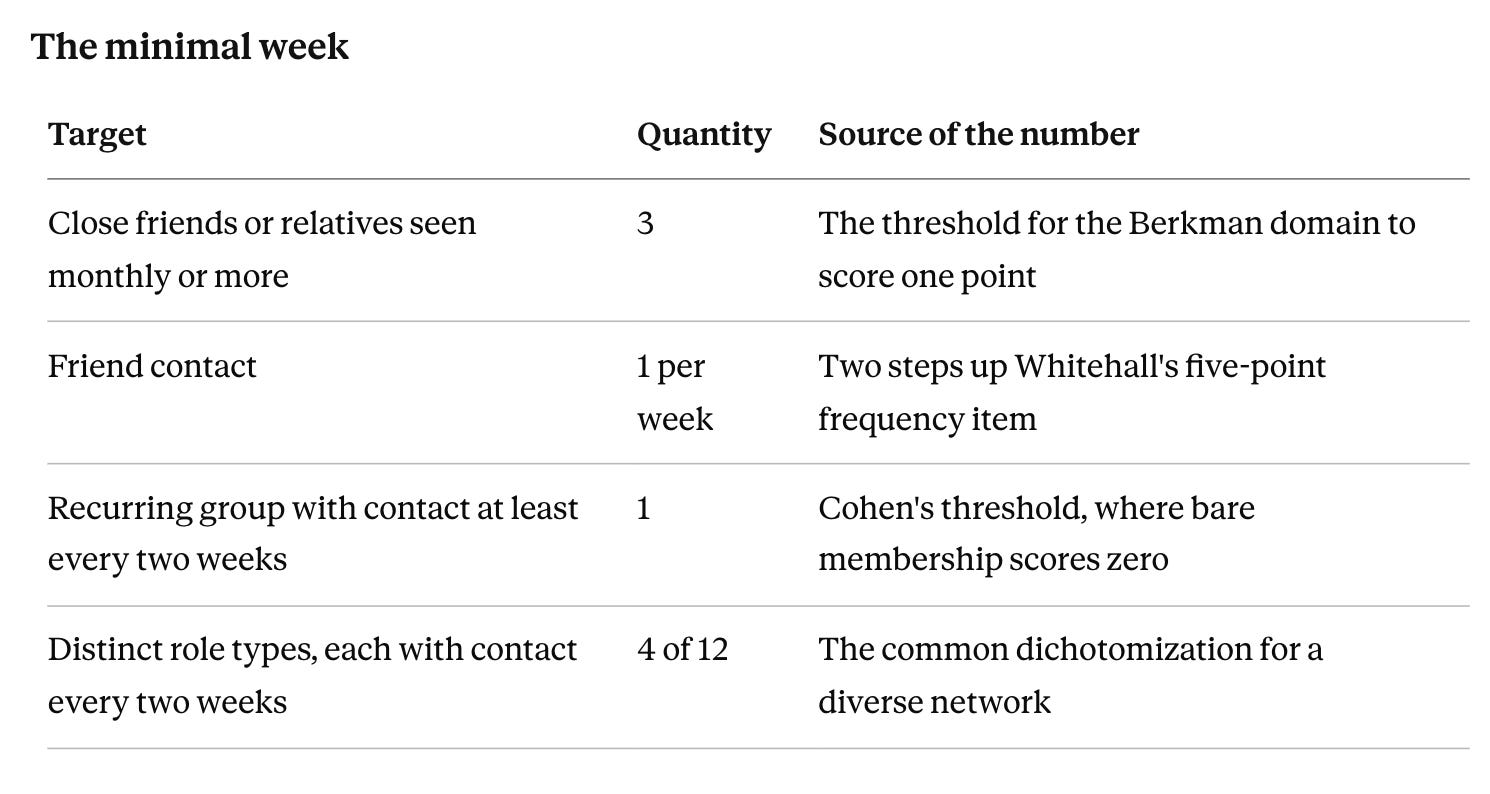
That comes to roughly three to four hours a week of social time.
The ideal week
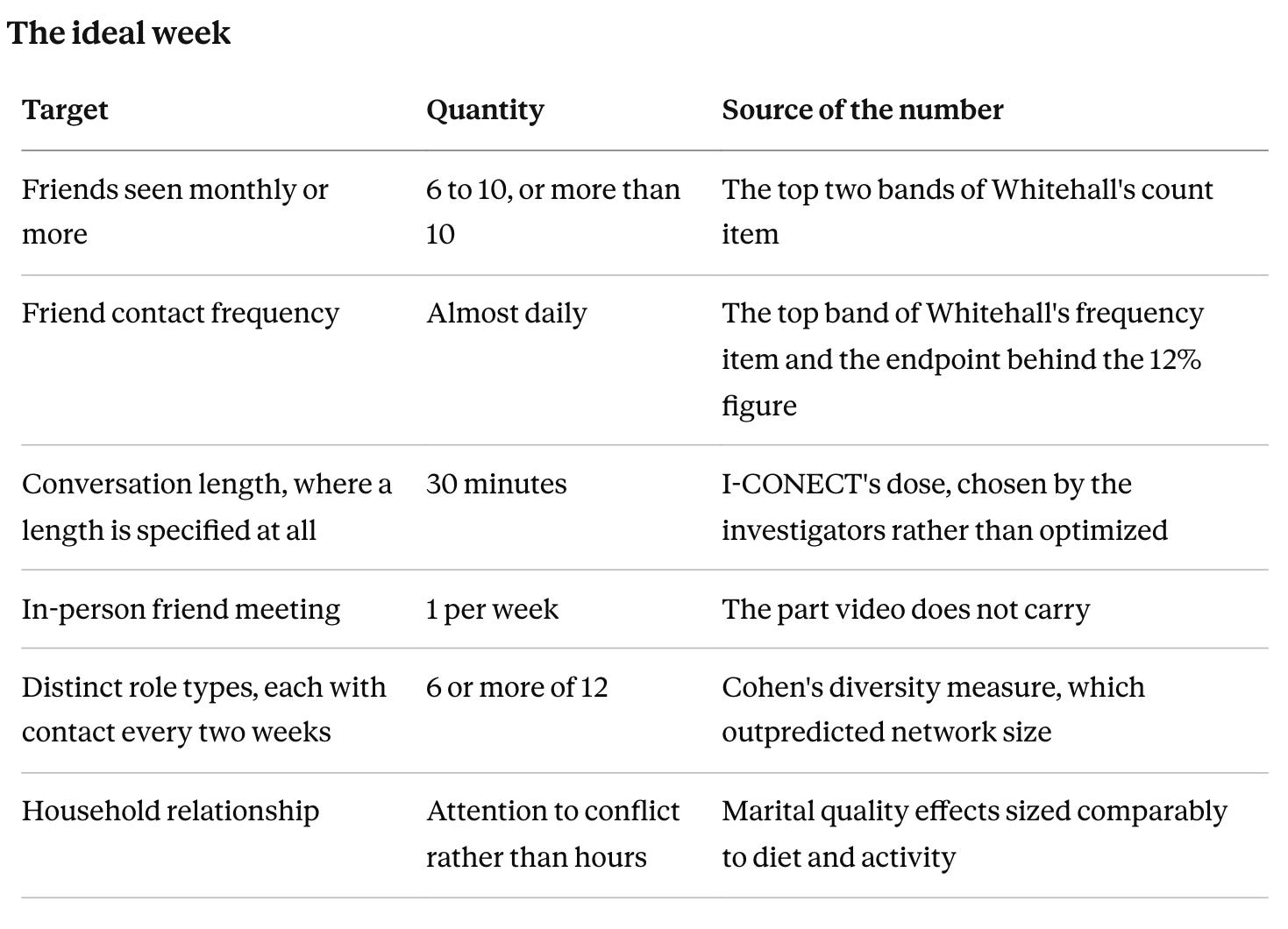
Added up, the ideal week contains about five to seven hours of community time, most of it near-daily contact of thirty minutes with various people with at least one weekly hang in person.
A sample week
To make the ideal week concrete, here is one way it lands on a calendar. The daily thirty-minute slot rotates across kinds of tie rather than spending every day on the same one or two people, since variety is the axis that outpredicted volume. Lunch is the easier daily unit because it fits inside a workday. The longer weekend hang gives two or three hours in person.
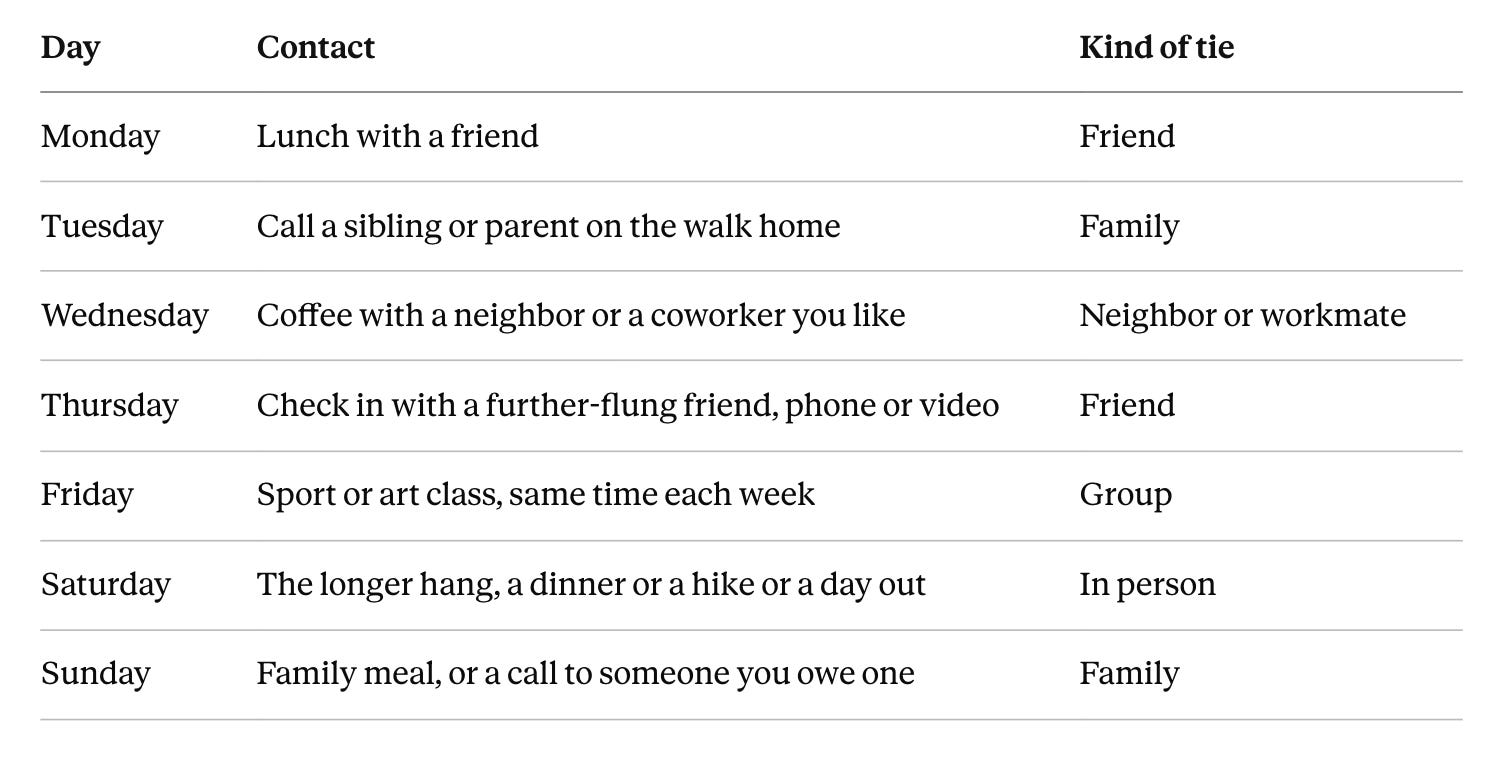
A few more kinds of relationship stay current at the every-two-weeks level rather than daily, a neighbor, a former colleague, the recurring class where the same faces recur, and whoever is at home. That is what carries the count past four kinds of tie toward six.
The daily social interaction is the crucial factor, so attaching it to something already in the day, the commute or lunch or the walk home, keeps it from requiring too much willpower. A sport counts only when talking is built into it, a doubles match or a climbing session or a class with chatter, not lap swimming beside strangers. If the sport is the silent kind, the conversation over coffee afterward is what counts, not the exercise.
Two caveats to be aware of. This schedule is assembled from studies that each measured one part of the question so it is a reasonable synthesis rather than a tested protocol. The second point is that the diversity-and-rotation emphasis is better evidenced for general health, from the cold and mortality data, than specifically for the brain, where the friends-carried-the-signal finding leans a little toward depth over breadth. If your highest priority is brain aging rather than overall health, weight the friend slots a bit heavier and worry less about hitting all six categories.
If you are looking for a like-minded community to join, considering becoming a member of my non-profit, Longevity Global. We host events in 20+ cities around the world and basic membership is free.


Written by
Dr. Christin Glorioso, MD PhD
Dr. Glorioso is the founder and CEO of NeuroAge Therapeutics. With her background in neuroscience and medicine, she is dedicated to revolutionizing brain health and helping people maintain cognitive vitality.
Learn more about Dr. Glorioso

